Best 7 Indian Air Force Fighter Jets in 2027
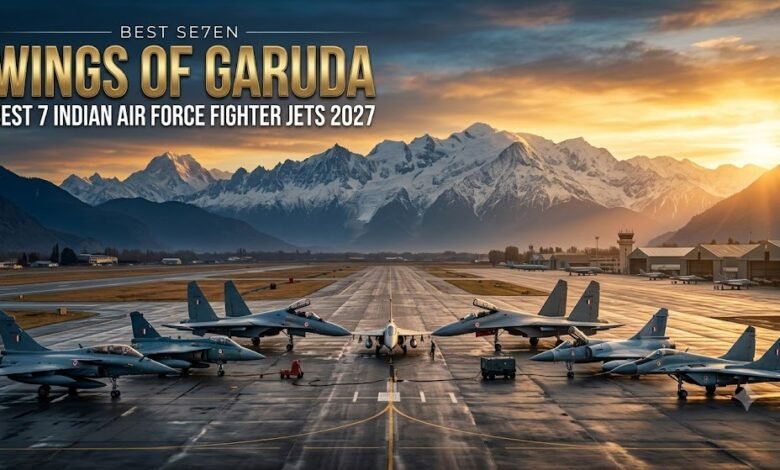
The modern Indian Air Force is built on speed, precision, and layered combat power. In 2027, the fleet will likely reflect a sharper mix of proven platforms and upgraded frontline aircraft, making the choice of the best Indian Air Force fighter jets more relevant than ever.
This list focuses on aircraft that offer real combat value through range, sensors, weapons integration, survivability, and mission flexibility. Each jet on this list plays a distinct role in air defense, strike, electronic warfare, or deterrence.

1. Sukhoi Su-30MKI
The Sukhoi Su-30MKI remains the backbone of India’s air superiority force and will continue to be one of the most important Indian Air Force fighter jets in 2027. Its large size, twin-engine layout, and long combat radius make it ideal for deep patrols and long-range strike missions.
What makes the Su-30MKI especially valuable is its adaptability. The aircraft can carry a wide range of air-to-air, air-to-ground, and anti-ship weapons, while Indian upgrades continue to improve radar, avionics, and electronic warfare systems.
Its thrust-vectoring control and strong payload capacity also give it an edge in close-range maneuvering and heavy strike roles. For a large air force operating across difficult geography, that mix is hard to replace.
2. Dassault Rafale
The Rafale is one of the most advanced Indian Air Force fighter jets in service, and it brings a true multirole edge. It is built for high-end combat, with excellent sensor fusion, strong electronic warfare capability, and high mission survivability.
In practical terms, the Rafale is a first-choice jet for contested airspace. Its ability to launch long-range precision weapons, operate with low observability features, and share targeting data across platforms makes it a modern force multiplier.
Its combat value is especially strong in quick-reaction strike and air dominance missions. With a mature weapons suite and excellent operational reliability, the Rafale is likely to remain a premium asset through 2027 and beyond.
3. HAL Tejas Mk1A
The Tejas Mk1A is a major step forward for India’s indigenous fighter development. It is lighter than the Su-30MKI and Rafale, but its value lies in agility, lower operating cost, and modern mission systems designed for daily frontline use.
This aircraft is important because it helps expand squadron strength without putting excessive strain on the defense budget. It features improved radar, better self-protection systems, and stronger maintainability than earlier Tejas variants.
For air policing, interception, and point-defense missions, the Tejas Mk1A offers a smart balance of performance and economy. In 2027, it will be one of the most practical Indian Air Force fighter jets for routine operational readiness.
4. Mirage 2000I/TH
The Mirage 2000 has earned a strong reputation in Indian service for precision, reliability, and battle-tested performance. Even as newer platforms enter the force, its upgraded Indian variant remains highly relevant because of its sharp avionics and proven strike capability.
This jet is particularly strong in surgical missions. It can deliver precision-guided weapons with confidence, and its smaller size makes it a dependable choice for operations that require fast response and accurate targeting.
The Mirage 2000 also benefits from a long service history in India, which means the Air Force knows how to use it effectively. That operational maturity is a real advantage in high-pressure situations.
5. MiG-29UPG
The MiG-29UPG continues to be a useful high-performance fighter in the Indian inventory. Its twin-engine design, strong acceleration, and agile airframe make it well suited for defensive counter-air and quick scramble missions.
This aircraft remains valuable because it can respond fast to airborne threats and operate effectively in short-notice combat scenarios. Its upgraded radar and avionics also help it stay relevant in a modern battlespace.
Although newer aircraft may surpass it in sensor integration, the MiG-29UPG still delivers strong raw performance. In a layered force structure, it fills an important role as a dependable and aggressive interceptor.
6. HAL Tejas Mk2
The Tejas Mk2 is expected to become one of the most important future Indian Air Force fighter jets. It is designed as a larger and more capable evolution of the Tejas family, with better range, payload, and avionics than the Mk1A.
This aircraft matters because it bridges the gap between light fighters and heavy multirole jets. It is expected to carry modern sensors, stronger electronic warfare systems, and a wider weapons load, making it much more flexible for strike and air defense.
If development and induction stay on track, the Tejas Mk2 could become a central pillar of India’s future combat fleet. It also represents a critical step in reducing long-term dependence on imported fighters.
7. Sukhoi Su-57 (Potential Future Induction)
The Su-57 is not a current mainstay, but it is often discussed as a possible future addition to the Indian Air Force fighter jets ecosystem. If inducted, it would bring fifth-generation capabilities that emphasize stealth, advanced sensors, and high-end survivability.
Its appeal lies in how it could reshape air combat doctrine. A stealth-capable fighter can detect, track, and engage threats while reducing its own visibility, which is a major advantage in contested environments.
For India, such an aircraft would be strategically important in long-range deterrence and deep strike missions. However, any future role would depend on cost, technology access, integration planning, and long-term support commitments.
Summary Comparison
| Fighter Jet | Role | Key Strengths | Typical Advantage in 2027 | Overall Status |
|---|---|---|---|---|
| Su-30MKI | Air superiority, strike | Long range, heavy payload, versatility | Backbone of large-scale operations | In service, highly important |
| Rafale | Multirole, precision strike | Sensor fusion, EW, survivability | Elite high-end combat platform | In service, premium asset |
| Tejas Mk1A | Light multirole | Low operating cost, modern avionics, agility | Efficient frontline coverage | In induction/expansion phase |
| Mirage 2000I/TH | Precision strike, interception | Reliability, accuracy, proven combat record | Fast, dependable mission execution | In service, mature platform |
| MiG-29UPG | Interception, air defense | Acceleration, agility, twin-engine safety | Quick response and defensive combat | In service, useful niche role |
| Tejas Mk2 | Future multirole | Larger payload, better range, modern systems | Major indigenous capability upgrade | Future induction candidate |
| Su-57 | Fifth-generation combat | Stealth, advanced sensors, deep strike potential | High-end future deterrence | Potential future acquisition |

Frequently Asked Questions (FAQs)
Which is the most important fighter jet in the Indian Air Force today?
The Su-30MKI remains the most important because it combines range, payload, and multirole flexibility at scale.
Why is the Rafale considered one of the best Indian Air Force fighter jets?
It offers advanced sensors, strong electronic warfare systems, and excellent precision strike ability in contested airspace.
Will indigenous fighters become more important in 2027?
Yes. The Tejas Mk1A and Tejas Mk2 are central to India’s long-term goal of building a stronger domestic combat fleet.
Are older jets like the Mirage 2000 and MiG-29 still relevant?
Yes. After upgrades, both remain effective for interception, strike, and rapid response missions.
Conclusion
The Indian Air Force fighter jets fleet in 2027 will likely be defined by a blend of heavy hitters, agile multirole aircraft, and growing indigenous strength. The Su-30MKI and Rafale will anchor high-end combat, while the Tejas family will improve fleet depth and self-reliance.
This mix is not just about having more aircraft. It is about having the right aircraft for the right mission, backed by upgrades, training, and weapons integration. That balance will decide how strong and adaptable the Indian Air Force fighter jets force remains in the years ahead.