7 Best Strategic Stealth Bombers in 2027
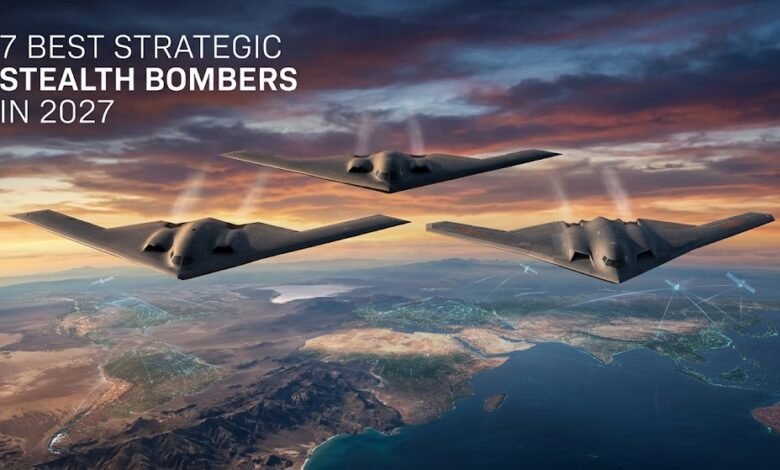
The future of long-range airpower is being shaped by a new generation of Strategic Stealth Bombers built to penetrate advanced air defenses, carry large payloads, and operate across vast distances. In 2027, the best platforms are judged not only by range and survivability, but also by sensor fusion, networking, weapons flexibility, and the ability to remain relevant against peer threats.
This list focuses on seven bombers that define modern strategic strike capability. Some are already in service, while others are expected to enter or approach operational maturity by 2027.
the 7 Best Strategic Stealth Bombers in 2027

1. Northrop Grumman B-21 Raider
The B-21 Raider is the most important new bomber program in the world and the clearest sign of where Strategic Stealth Bombers are heading. Designed for deep penetration, it uses a flying-wing shape, advanced low-observable materials, and a digital-first architecture that should make upgrades faster and cheaper than older fleets.
What makes the B-21 exceptional is not just stealth, but adaptability. It is expected to integrate advanced networking, electronic warfare support, and both conventional and nuclear missions. That flexibility allows it to operate as a strike bomber, a sensor node, or a command-and-control asset in a contested environment.
By 2027, the Raider will still be early in its service life, but its significance is already huge. For planners, it represents the most survivable long-range strike option among Strategic Stealth Bombers and the benchmark for future designs.
2. Northrop Grumman B-2 Spirit
The B-2 Spirit remains one of the most effective stealth bombers ever built. Its flying-wing design and ultra-low radar signature allow it to penetrate highly defended airspace, and its combat record has proven its value in both deterrence and precision strike roles.
Even in 2027, the B-2 stays relevant because stealth is still a decisive advantage against integrated air defense systems. It can deliver a wide range of precision-guided munitions and has been upgraded over time to improve communications, sensors, and weapons compatibility.

Its main limitation is fleet size and sustainment complexity. The B-2 is expensive to maintain and relies on specialized support, but when mission success matters most, it remains one of the most trusted Strategic Stealth Bombers in the inventory.
3. Xian H-20
China’s H-20 is expected to be a major force multiplier if it becomes operational near 2027. Although many details remain classified or unconfirmed, the aircraft is widely assessed as a long-range stealth bomber designed to extend China’s strike reach well beyond the first island chain.
The H-20 is important because it is likely built to deliver both conventional and nuclear payloads while reducing detectability against advanced radar networks. In strategic terms, this would allow China to threaten regional bases, maritime forces, and critical infrastructure from standoff distances.
Its exact performance remains uncertain, but the concept itself is powerful. If fielded as expected, the H-20 could become one of the most consequential Strategic Stealth Bombers in Asia-Pacific deterrence planning.
4. Tupolev PAK DA
The Russian PAK DA is intended to replace or complement legacy long-range bombers with a new stealth platform focused on survivability and range. The design is believed to emphasize low observability, subsonic efficiency, and the ability to launch stand-off weapons from outside dense air defenses.
For Russia, this aircraft matters because it would provide a modern strategic strike option without relying solely on older Tu-95 or Tu-160 fleets. A stealth bomber would also help improve survivability in a future conflict where radar coverage, fighter interception, and missile defenses are much stronger.
The schedule has been slow, and timelines remain uncertain, but the PAK DA still belongs in any serious discussion of Strategic Stealth Bombers. If it reaches service, it will likely serve as a high-end nuclear deterrent and a conventional long-range strike asset.
5. Northrop Grumman B-1B Lancer
The B-1B is not a pure stealth bomber like the B-2 or B-21, but it still plays a strategic role because of its range, payload, and mission flexibility. Its variable-sweep wing design gives it high speed and strong weapon carriage, and modernization has kept it relevant in precision strike operations.
In 2027, the B-1B is valuable as a mass-payload platform that can deliver large quantities of conventional munitions. While its radar signature is much larger than that of true stealth bombers, tactical upgrades and stand-off weapons help it stay useful in lower-risk or supported environments.
It demonstrates an important point: strategic impact is not only about stealth alone. In a mixed fleet, the B-1B complements more survivable Strategic Stealth Bombers by carrying heavy loads and covering a wide set of mission profiles.
6. Tupolev Tu-160M
The Tu-160M is a modernized version of Russia’s iconic supersonic bomber. It is not stealthy in the same way as a flying-wing bomber, but its speed, altitude, and long-range missile load still make it a serious strategic platform.
The Tu-160M remains relevant because it can launch cruise missiles from standoff range, reducing the need to enter heavily defended airspace. Upgrades to avionics, communications, engines, and weapons handling improve its endurance as a deterrent system in the 2027 environment.
It is best viewed as a bridge between older bomber doctrine and newer low-observable concepts. While it cannot match the survivability of true Strategic Stealth Bombers, it offers a powerful combination of range, payload, and rapid response.
7. Xian H-6N
The H-6N is a modernized derivative of the Soviet-era Tu-16, but it has evolved into a more strategically relevant aircraft than its origins suggest. With aerial refueling capability and the ability to carry large stand-off weapons, it has become a key part of China’s long-range strike and deterrence mix.
Its value lies in persistence and mission reach. Although it is not a stealth aircraft, it can operate as a launch platform for cruise missiles or air-launched ballistic weapons, which allows it to threaten high-value targets without directly entering the most dangerous air defense zones.
In the broader bomber ecosystem, the H-6N shows how older airframes can still matter when paired with modern weapons. It does not compete with true Strategic Stealth Bombers on survivability, but it can still shape adversary planning in a serious way.
Summary Comparison
| Bomber | Country | Stealth Level | Primary Role | Key Strength | Main Limitation |
|---|---|---|---|---|---|
| B-21 Raider | United States | Very High | Deep strike, nuclear deterrence | Next-generation survivability and networking | Still early in fielding |
| B-2 Spirit | United States | Very High | Precision strike, nuclear deterrence | Proven low-observable penetration | High maintenance burden |
| H-20 | China | Expected High | Strategic strike | Potential long-range regional deterrence | Limited public data |
| PAK DA | Russia | Expected High | Strategic strike, deterrence | Stealth-focused replacement concept | Program uncertainty |
| B-1B Lancer | United States | Low to Moderate | High-payload conventional strike | Large weapon load and speed | Not a true stealth bomber |
| Tu-160M | Russia | Low | Standoff missile delivery | Speed and range | Limited survivability vs modern defenses |
| H-6N | China | Low | Long-range missile carrier | Extended reach with modern weapons | Legacy airframe and low stealth |
Frequently Asked Questions (FAQs)
Which bomber is the most advanced in 2027?
The B-21 Raider is the most advanced overall because it combines stealth, networking, modular design, and multi-mission flexibility.
Are all Strategic Stealth Bombers nuclear capable?
Not all, but many are designed for dual-use roles. Nuclear capability depends on national doctrine, weapons integration, and certification.
Why do non-stealth bombers still matter?
They matter because they can carry heavy payloads, launch stand-off weapons, and support deterrence at lower cost than stealth platforms.
What is the biggest advantage of stealth bombers?
Their biggest advantage is survivability in heavily defended airspace, which allows them to strike targets that other aircraft may not reach safely.
Conclusion
The bomber landscape in 2027 is defined by a split between true low-observable penetration platforms and larger legacy aircraft adapted for stand-off attack. Among all Strategic Stealth Bombers, the B-21 Raider stands out as the most important platform for the future, while the B-2 Spirit remains a proven and highly capable threat.
At the same time, emerging aircraft like the H-20 and PAK DA could reshape deterrence if they reach maturity. Together, these bombers show that strategic airpower is still evolving fast, and stealth, range, payload, and networked warfare will decide which fleets dominate the next decade of conflict.