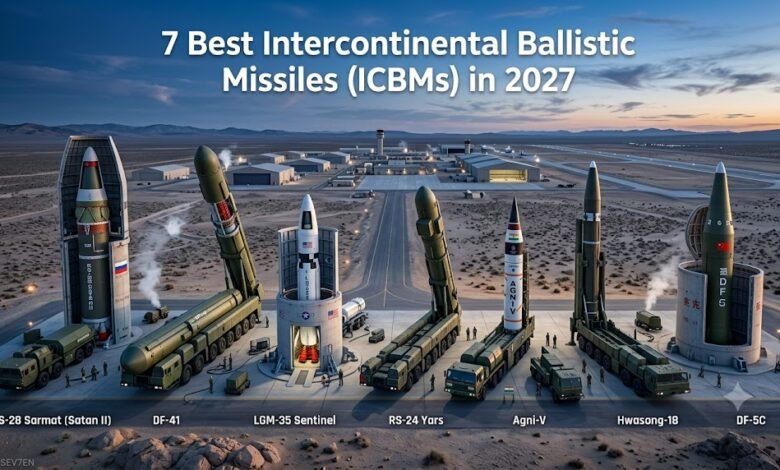
7 Best Intercontinental Ballistic Missiles in 2027
Intercontinental Ballistic Missiles are among the most consequential weapons ever developed in modern military history. In 2027, they remain a central part of strategic deterrence, nuclear triads, and long-range force projection for major powers.
This list focuses on the 7 best systems based on range, payload flexibility, accuracy, survivability, launch readiness, and modernization level. It is a technical and strategic comparison, not a ranking of political intent or national power.
1. LGM-35A Sentinel
The LGM-35A Sentinel is the United States’ next-generation land-based deterrent and one of the most important Intercontinental Ballistic Missiles in 2027. It is designed to replace the aging Minuteman III fleet with modern electronics, improved command-and-control integration, and better resistance to cyber and environmental threats.
Its biggest advantage is survivability through modernization rather than raw headline range. The Sentinel is expected to support improved guidance, maintainable launch infrastructure, and a more secure architecture for decades of service. That matters because reliability is just as important as warhead capacity in strategic deterrence.
For military planners, the Sentinel represents continuity with a more resilient design philosophy. It is built to ensure rapid response while reducing the maintenance burden that older silo-based missiles often require.


2. RS-28 Sarmat
The RS-28 Sarmat is widely regarded as one of the most formidable Intercontinental Ballistic Missiles in service. Designed by Russia as a heavy liquid-fueled system, it is intended to carry a very large payload over extremely long distances.
Its strength lies in brute force and flexibility. The missile is reported to support multiple reentry vehicles, possible hypersonic glide payloads, and complex penetration aids that can challenge missile defense systems. That makes it strategically significant even beyond its raw range figures.
Heavy ICBMs like Sarmat are especially relevant in a world where missile defense is improving. By increasing payload options and flight-path complexity, they preserve the credibility of deterrence against advanced interception networks.
3. DF-41
China’s DF-41 is one of the most advanced road-mobile Intercontinental Ballistic Missiles in 2027. Its mobility is a major strategic advantage because it complicates detection, targeting, and preemptive strikes.
The DF-41 is believed to offer very long range and support multiple independently targetable reentry vehicles, or MIRVs. That combination gives it both reach and flexibility, allowing a small number of launchers to threaten multiple strategic targets.
Mobile basing also improves survivability. A missile that can move, hide, and launch from dispersed locations is much harder to neutralize than a fixed silo-only system, especially during crisis conditions.
4. Minuteman III
The Minuteman III remains one of the most proven Intercontinental Ballistic Missiles ever fielded. Even though it is an older design, it continues to matter because of sustained upgrades, operational discipline, and a long history of successful deterrent patrols.
Its core advantage is dependable performance. The missile has benefited from decades of testing, refurbishment, and electronics updates, which have allowed it to remain a credible part of the U.S. strategic arsenal well into the 2020s.
In strategic terms, Minuteman III demonstrates a key lesson: an ICBM does not need to be the newest system to remain effective. If maintenance, launch command reliability, and warhead integration are strong, it can still provide serious deterrent value.
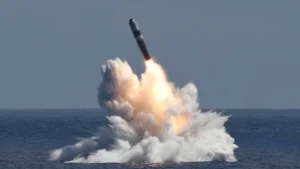
5. Trident II D5
Although commonly associated with submarine launch rather than silo basing, the Trident II D5 belongs on any serious list of Intercontinental Ballistic Missiles. Its sea-based launch platform makes it one of the most survivable strategic systems in existence.
Its strength is not just range, but second-strike credibility. A submarine-launched missile system is far harder to track and destroy before launch, which is why it plays such a crucial role in nuclear strategy. The Trident II D5 has also benefited from continuous upgrades in guidance and reliability.
For policymakers, this missile is a reminder that survivability often matters more than sheer size. A weapon hidden beneath the ocean can be more strategically stabilizing than a larger but more exposed system.
6. Agni-V
India’s Agni-V is one of the most important strategic missiles in Asia and a major example of a modernizing national deterrent. It is widely understood as a long-range system that extends India’s strategic reach and strengthens its posture of credible minimum deterrence.
One of its main strengths is its balance of range, portability, and modernization. The missile supports India’s broader objective of maintaining a secure retaliatory capability without pursuing unnecessary excess. That makes it strategically efficient as well as politically significant.
Agni-V also reflects how regional power dynamics shape missile development. Its deployment signals technological maturity and provides a strong deterrent effect without requiring the scale of the largest superpower arsenals.
7. KN-08 / Hwasong-17 Class
North Korea’s road-mobile long-range ballistic missile class, often associated with the KN-08 and Hwasong-17 family, remains one of the most watched strategic programs in the world. While operational details are harder to verify than for established powers, the system’s potential impact is impossible to ignore.
Its strategic value comes from unpredictability and political signaling. Even when technical maturity is debated, a missile class with very long-range potential forces adversaries to account for worst-case scenarios. That is often enough to influence deterrence planning.
The mobile launch format adds another layer of complexity. If the system can be dispersed and launched from concealed positions, it becomes far harder to counter, especially in a crisis with limited warning time.
Summary Comparison
| Missile System | Country/Operator | Launch Type | Approx. Strategic Strength | Key Advantage | Main Limitation |
|---|---|---|---|---|---|
| LGM-35A Sentinel | United States | Silo-based | High | Modern command, security, and long-term reliability | Not yet fully fielded |
| RS-28 Sarmat | Russia | Silo-based | Very High | Massive payload and penetration capability | Large, high-profile fixed target |
| DF-41 | China | Road-mobile | Very High | Mobility and MIRV flexibility | Public technical data is limited |
| Minuteman III | United States | Silo-based | High | Proven reliability and mature sustainment | Older design architecture |
| Trident II D5 | United States / UK | Submarine-launched | Very High | Exceptional survivability and second-strike role | Depends on submarine platform |
| Agni-V | India | Road-mobile / canisterized | High | Strong regional deterrence and mobility | Smaller arsenal scale |
| Hwasong-17 class | North Korea | Road-mobile | Medium to High | Strategic ambiguity and signaling power | Operational confidence remains uncertain |
Frequently Asked Questions (FAQs)
What makes Intercontinental Ballistic Missiles so important in 2027?
They remain central to nuclear deterrence because they can deliver warheads over vast distances in a short time, making them powerful tools for second-strike credibility and strategic stability.
Which is the most survivable ICBM type?
Submarine-launched systems are generally the most survivable because they are hardest to detect and target before launch. Mobile land-based systems also offer strong survivability compared with fixed silos.
Are older systems like Minuteman III still relevant?
Yes. Older systems can remain relevant if they receive consistent upgrades, reliable maintenance, and secure command-and-control support. Age alone does not determine usefulness.
Why do mobile ICBMs matter so much?
Mobile launchers are harder to track and destroy, which increases their survivability. They also complicate enemy planning, making deterrence more credible.
Conclusion
The strategic landscape in 2027 shows that Intercontinental Ballistic Missiles are still defined by a balance of range, survivability, payload flexibility, and command reliability. Whether silo-based, mobile, or submarine-launched, the best systems are those that preserve credible deterrence under pressure.
From the modern Sentinel to the heavily armed Sarmat, these missiles reflect how advanced military powers adapt to changing defense technologies and strategic risks. In the end, Intercontinental Ballistic Missiles remain less about symbolism and more about ensuring that no adversary mistakes capability for weakness.