
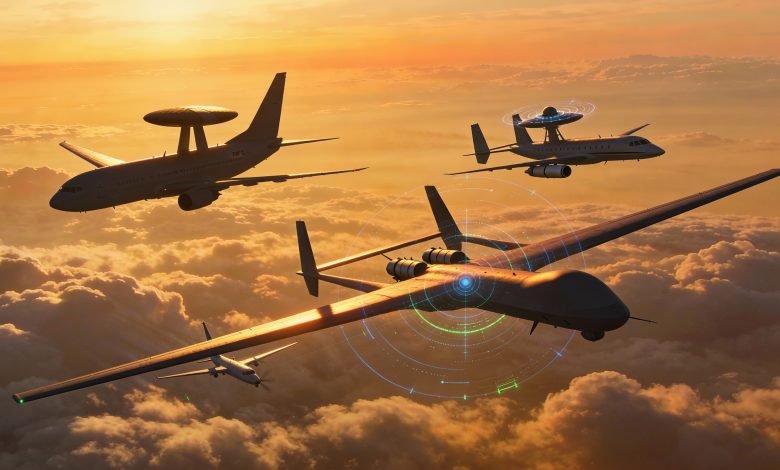
Best 7 Reconnaissance and Early Warning Aircraft in 2026
The development of reconnaissance and early warning aircraft in 2026 proves that in modern global conflicts, the first critical advantage almost always belongs to the side that sees the battlefield first. That is precisely why modern airborne early warning and control (AEW&C) platforms often described by military experts as flying command posts and flying sensor hubs remain absolutely central to modern deterrence and defense planning.
Unlike front-line stealth fighters or heavy bombers, these strategic platforms rarely dominate mainstream headlines. Yet, their highly classified work shapes nearly everything that follows: warning of incoming ballistic threats, directing fighter intercepts, guiding friendly aircraft through heavily contested airspace, and collecting massive amounts of electronic intelligence.
In short, they turn raw radar data into actionable battlefield awareness, keeping crews and critical ground infrastructure safe by entirely eliminating the element of surprise.
In this comprehensive guide, we will explore the elite surveillance platforms that are dominating the skies this year.
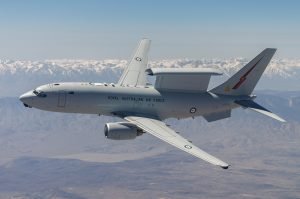
1- Boeing E-7 Wedgetail
The Boeing E-7 Wedgetail is widely viewed by defense analysts as the leading modern successor to legacy AWACS concepts. By pairing a reliable, cost-effective 737-derived airframe with the highly distinctive fixed Multi-role Electronically Scanned Array (MESA) radar, it provides unparalleled wide-area surveillance and battle management. As a leading choice among the top reconnaissance and early warning aircraft in 2026, its role is not simply detecting adversary aircraft—it is actively helping coordinate what allied forces do next. This includes tracking hypersonic targets, prioritizing threats, and securing encrypted communications across the entire joint force. The U.S. Air Force is heavily investing in the E-7 as its future flagship radar platform.
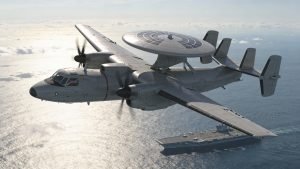
2- Northrop Grumman E-2D Advanced Hawkeye
Specifically designed to operate from the deck of nuclear-powered aircraft carriers, the E-2D Advanced Hawkeye provides critical airborne early warning and command-and-control for naval task forces and massive joint operations. A key part of its immense capability is the powerful AN/APY-9 radar. This rotating radome is built for wide-area detection and tracking in highly demanding maritime environments where stealthy cruise missiles and low-flying targets can be extremely difficult to separate from background ocean clutter. It remains a foundational pillar of carrier strike groups worldwide.

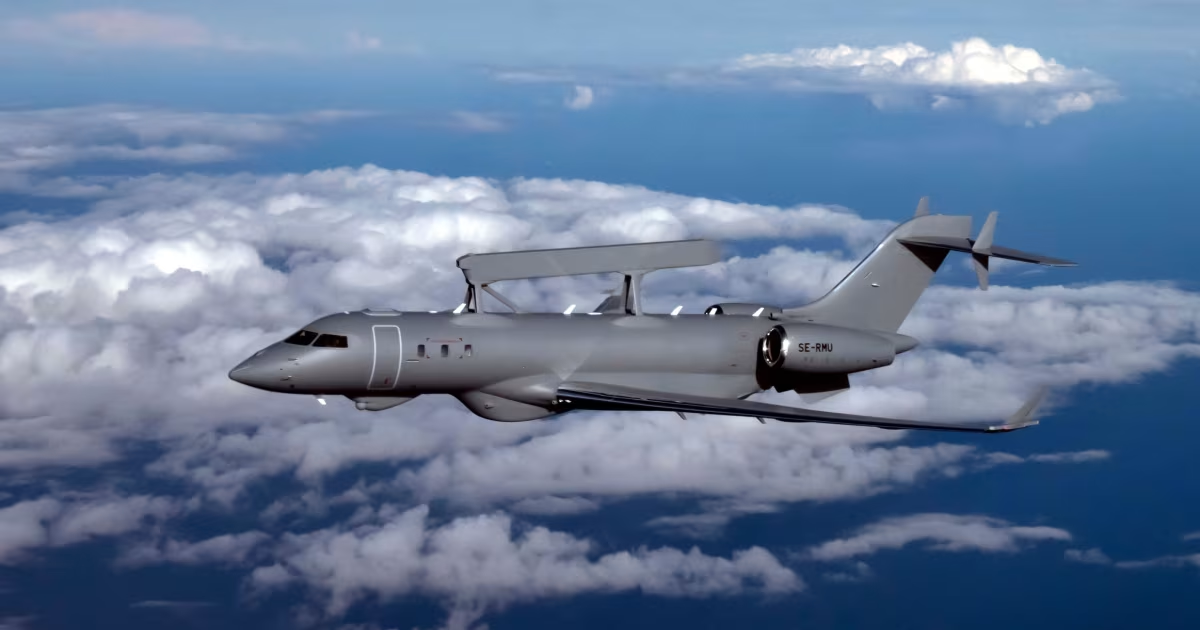
3- Saab GlobalEye
Saab’s GlobalEye is positioned as a highly advanced, long-range surveillance aircraft aimed at giving military operators a broad, unified view across air, sea, and land domains. When analyzing the most versatile reconnaissance and early warning aircraft in 2026, the GlobalEye stands out due to its “multi-domain” framing. Modern commanders increasingly need one shared tactical picture that seamlessly supports air defense, maritime situational awareness, and ground troop movements without relying on multiple single-sensor aircraft. Built on a modified Bombardier Global 6000 business jet and equipped with the Erieye ER radar, it offers exceptional endurance and rapid deployment capabilities.
4. IAI EL/W-2085 CAEW (G550)
Israel Aerospace Industries’ EL/W-2085 CAEW (Conformal Airborne Early Warning) solution elegantly integrates a continuous 360-degree early-warning capability using conformal AESA radar arrays seamlessly built into a Gulfstream G550-based platform. This unique aerodynamic design approach is directly associated with highly efficient radar coverage and exceptionally strong data connectivity. These are core requirements for modern AEW&C missions where the speed of electronic detection and the speed of data sharing matter just as much as the aircraft’s maximum flight range.
5. Boeing E-3 Sentry
The Boeing E-3 Sentry remains one of the best-known and most iconic AWACS aircraft in military history. Instantly recognizable by its massive rotating radar dome, it has provided airborne surveillance and critical battle-management functions that have been foundational to NATO and allied air operations for decades. While many global air forces are actively planning transitions to newer digital systems, the E-3’s core mission set—detect, track, coordinate, and securely control—still firmly defines what an airborne warning fleet is fundamentally expected to deliver on the modern battlefield.
6. Boeing RC-135V/W Rivet Joint
While many planes look for physical targets, the RC-135V/W Rivet Joint is exclusively built around Signals Intelligence (SIGINT). It focuses heavily on collecting, analyzing, and disseminating highly classified electronic intelligence often in near real-time to support operational decision-making at the highest levels. Standing out among other reconnaissance and early warning aircraft in 2026, it plays a very different role than standard AEW&C platforms. Instead of primarily managing a kinetic air battle, it helps reveal exactly what adversary air defense systems are doing by finding and characterizing hostile emissions that indicate radar activity, secure communications, and broader electronic warfare patterns.
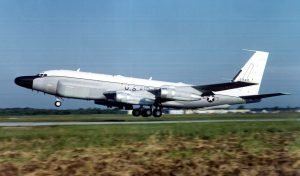
7. Northrop Grumman RQ-4 Global Hawk
The RQ-4 Global Hawk is an uncrewed, high-altitude, long-endurance (HALE) drone system intended for broad-area, all-weather intelligence, surveillance, and reconnaissance (ISR). According to extensive defense data from Northrop Grumman, its immense strategic value comes from its unprecedented persistence and highly integrated sensor suite. Unbound by human fatigue limits, the Global Hawk can stay on station at 60,000 feet for over 30 hours, silently building a perfectly clear intelligence picture of ground movements in heavily contested regions.
Tactical Summary: Platform Comparison
| Aircraft Platform | Primary Manufacturer | Core Mission Profile | Key Radar / Sensor Tech |
| Boeing E-7 Wedgetail | Boeing (USA) | AEW&C / Battle Management | Fixed MESA AESA Radar |
| E-2D Advanced Hawkeye | Northrop Grumman (USA) | Carrier-based AEW&C | AN/APY-9 Rotating Radar |
| Saab GlobalEye | Saab (Sweden) | Multi-Domain Surveillance | Erieye ER AESA Radar |
| IAI CAEW (G550) | IAI (Israel) | Airborne Early Warning | Conformal AESA Arrays |
| Boeing E-3 Sentry | Boeing (USA) | Legacy AWACS Control | APY-1/2 Passive Radar |
| RC-135V/W Rivet Joint | Boeing (USA) | Signals Intelligence (SIGINT) | Advanced ELINT Suite |
| RQ-4 Global Hawk | Northrop Grumman (USA) | Unmanned HALE ISR | Integrated SAR & EO/IR |
Frequently Asked Questions (FAQs)
Why are AEW&C aircraft critical in modern warfare?
In highly contested airspace, modern reconnaissance and early warning aircraft in 2026 serve as the central nervous system of the military. They dramatically shorten the time between threat detection and tactical decision-making, providing fighter jets and ground defense units with critical minutes to classify targets and safely respond.
What is the difference between AWACS and SIGINT aircraft?
AWACS (Airborne Warning and Control System) aircraft, like the E-7 Wedgetail or E-3 Sentry, use massive active radars to physically track enemy jets and coordinate friendly fighters. In contrast, SIGINT aircraft, like the RC-135 Rivet Joint, silently “listen” to enemy radio and radar emissions to gather electronic intelligence without actively emitting large radar signatures themselves.
Are drones replacing manned early warning aircraft?
While unmanned HALE drones like the RQ-4 Global Hawk are excellent for long-endurance surveillance and mapping, manned platforms remain essential. Complex reconnaissance and early warning aircraft in 2026 require highly trained human battle managers on board to make split-second, life-or-death tactical decisions during chaotic air engagements.
Conclusion
What fundamentally links all seven of these incredible military aircraft is not a single radar model or aerodynamic frame, but a unified mission: shortening the critical time between detection and decision. For combat fighter pilots, that can mean earlier threat warnings and safer routing. For ground-based air-defense units, it can mean gaining more time to classify an incoming ballistic target and deploy interceptors. In today’s highly unpredictable security climate, the strategic advantage of seeing the enemy first and sharing that data fast remains one of the absolute strongest forms of protection a military force can possibly provide.


Hello, this is a good article and you have a great writing style, but your style needs more images and a broader presentation of information. I hope to see more good articles in this section.
Hello, this is a good article and you have a great writing style, but your style needs more images and a broader presentation of information. I hope to see more good articles in this section.
Hello my loved one! I wish to say that this article is awesome, nice written and include approximately all significant infos. I’d like to peer extra posts like this.
Keep functioning ,fantastic job!
Thanks for sharing excellent informations. Your site is so cool. I’m impressed by the details that you?¦ve on this web site. It reveals how nicely you understand this subject. Bookmarked this web page, will come back for more articles. You, my pal, ROCK! I found simply the information I already searched all over the place and just could not come across. What a perfect web-site.
Your style is so unique compared to many other people. Thank you for publishing when you have the opportunity,Guess I will just make this bookmarked.
Howdy very nice web site!! Man .. Excellent .. Wonderful .. I will bookmark your web site and take the feeds additionally?KI’m happy to find so many useful information right here in the put up, we want work out more techniques in this regard, thanks for sharing. . . . . .
I got good info from your blog