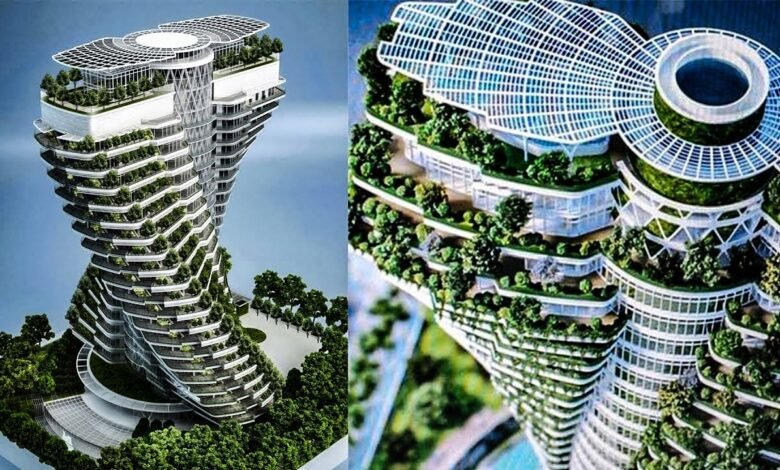
7 Best Smart Mega Skyscrapers 2026 Eco-Architecture Guide
The future of city building is changing fast, and Smart Mega Skyscrapers are at the center of that shift. These towers are no longer just symbols of height or wealth; they are becoming self-regulating urban systems that save energy, support cleaner living, and respond to the needs of millions of people.
As cities face land shortages, rising carbon goals, and growing populations, the best skyscrapers are being designed as intelligent ecosystems. They combine advanced structure, digital control, renewable energy, and sustainable materials to shape a new model for high-density urban life.
7 Best Smart Mega Skyscrapers (2026 Eco-Futuristic Architecture)
1. Burj Khalifa, Dubai
Burj Khalifa remains one of the most important examples of how extreme height can be paired with environmental performance. Its engineering is not only about scale, but also about managing heat, wind, and energy use in a desert climate.
The tower uses a high-performance cladding system to reduce solar gain, which is essential in Dubai’s intense heat. Its cooling systems and vertical transportation network are also designed to reduce waste and improve occupant comfort in a very tall building.
What makes it relevant to Smart Mega Skyscrapers is the way it integrates structural logic with climate response. The stepped form reduces wind pressure, and that directly improves efficiency in both construction and operation.
For developers, the lesson is clear: a supertall tower must be designed from the beginning as a climate machine, not just a visual landmark.
2. Shanghai Tower, Shanghai
Shanghai Tower is one of the clearest symbols of eco-futuristic design in modern architecture. Its twisting form is not just an aesthetic choice; it helps reduce wind loads, which lowers structural material demand and improves performance.
The tower is also known for its layered “vertical city” concept. It includes nine stacked zones, each with public spaces, retail, offices, and hospitality functions, which helps reduce the need for constant travel outside the building.

A major strength of Shanghai Tower is its energy strategy. It uses double-skin façade technology, wind turbines, rainwater collection, and a range of smart systems that optimize lighting, cooling, and energy distribution.
Among Smart Mega Skyscrapers, this building stands out because it treats sustainability as a core design principle rather than a decorative feature. It is a strong model for mixed-use urban towers in dense cities.
3. The Edge, Amsterdam
The Edge is not the tallest building on this list, but it is one of the smartest and most efficient office towers ever built. It has become a global benchmark for intelligent workplace design and sustainable operations.
The building uses a dense network of sensors to monitor occupancy, lighting levels, temperature, and energy use in real time. This allows the building to adapt to actual demand, which reduces waste and improves user experience.
Its solar panel coverage, energy storage systems, and smart lighting strategy make it highly efficient. Employees can also use an app to locate workspaces, book meeting rooms, and manage their daily routines more easily.
The Edge shows that Smart Mega Skyscrapers are not only about height. They are also about data, responsiveness, and the ability to optimize the human experience at scale.
4. Bosco Verticale, Milan
Bosco Verticale redefined the role of vegetation in high-rise design. Instead of treating greenery as decoration, the towers integrate large numbers of trees and plants directly into the façade and balconies.
This approach helps improve air quality, reduce heat gain, and support biodiversity in a dense urban setting. The vegetation also contributes to acoustic comfort and creates a more natural living environment for residents.
From a technical point of view, the project required careful structural planning because mature trees and soil add significant weight. Maintenance is also more complex, which means irrigation, pruning, and safety systems must be built into the operational model.
Bosco Verticale matters because it expands the idea of Smart Mega Skyscrapers beyond digital systems alone. It proves that ecological intelligence can be part of architecture itself.
5. One World Trade Center, New York
One World Trade Center is a powerful example of resilience, security, and sustainable design working together in a major commercial tower. While it is widely recognized for its symbolic meaning, its engineering and environmental strategy are equally important.
The building uses a highly efficient façade system, low-emission materials, and modern energy management tools. These features help reduce operating costs while supporting a healthier indoor environment.
Its structural core and blast-resistant design also reflect a new era in skyscraper planning, where safety and adaptability are just as important as aesthetics. In a city like New York, these qualities are essential for long-term relevance.
For Smart Mega Skyscrapers, this tower demonstrates that sustainability must work alongside resilience. The best towers are prepared for both environmental demands and real-world urban risks.
6. Taipei 101, Taipei
Taipei 101 is a landmark in green high-rise engineering, especially in a region exposed to typhoons and seismic activity. Its iconic tuned mass damper is one of the most famous structural devices in skyscraper history.
That damper reduces motion during strong winds and earthquakes, which improves safety and reduces wear on the building over time. This is a great example of how structural intelligence can support long-term efficiency.
The tower has also earned recognition for its environmental upgrades, including water efficiency systems, improved energy management, and green certification achievements. These efforts show that older megatowers can still evolve into smarter assets.
Among Smart Mega Skyscrapers, Taipei 101 is valuable because it combines structural resilience with retrofitted sustainability. It proves that performance can improve even after a building is already iconic.
7. Marina Bay Sands, Singapore
Marina Bay Sands is one of the most recognizable mixed-use developments in the world, and it has become a symbol of high-density urban innovation. Its design combines hospitality, retail, entertainment, and public space in one integrated complex.
The sky park connecting the towers is more than a visual feature. It creates shared outdoor space at an elevated level, which is an important strategy in very dense cities where ground-level land is limited.
Singapore’s broader planning culture also helps the project stand out. The city-state has strong green building standards, water management policies, and urban cooling goals, and Marina Bay Sands fits into that larger system.
This is a strong example of how Smart Mega Skyscrapers can support tourism, public space, and environmental performance at the same time. The future of tall building design is not isolated towers, but connected urban experiences.
Frequently Asked Questions (FAQs)
What makes a skyscraper “smart”?
A smart skyscraper uses sensors, automation, and data-driven systems to manage energy, lighting, ventilation, security, and space use more efficiently.
Why are mega skyscrapers important for sustainable cities?
They support high-density growth by reducing urban sprawl and concentrating people, services, and infrastructure in a smaller footprint.
Can older skyscrapers become smarter and greener?
Yes. Many older towers can be upgraded with better façades, LED lighting, smart controls, energy monitoring, and improved water systems.
Are Smart Mega Skyscrapers only for offices?
No. They can include homes, hotels, retail spaces, parks, transport links, and public amenities in one vertical mixed-use ecosystem.
Conclusion
The world’s most advanced towers are no longer judged only by height, but by how intelligently they perform in real life. Smart Mega Skyscrapers combine engineering, sustainability, digital systems, and human-centered design to create buildings that are more efficient, resilient, and useful for modern cities.
As urban populations grow and climate pressures rise, these towers will play a major role in shaping the next generation of architecture. The future belongs to skyscrapers that think, adapt, and contribute to the city around them.