Best 7 US Military Combat Drones in 2027
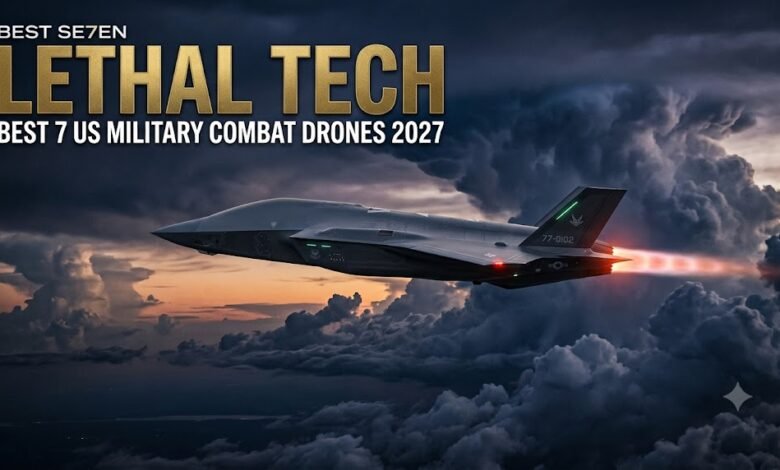
The next wave of air power is being shaped by US military combat drones, and 2027 is set to be a major turning point. These systems are no longer just support tools; they are becoming core assets for surveillance, strike, electronic warfare, and force protection.
What makes this topic important is not only speed or stealth. It is also autonomy, sensor fusion, survivability, and the ability to work alongside crewed aircraft in contested skies.
1. MQ-9 Reaper
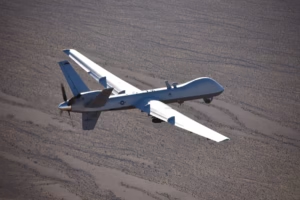
The MQ-9 Reaper remains one of the most recognizable US military combat drones and a benchmark for long-endurance armed surveillance. It has proven its value in persistent strike missions, intelligence collection, and real-time target tracking.
Its biggest strength is endurance. The Reaper can stay on station for many hours, giving commanders a steady picture of the battlefield and the ability to respond quickly when targets appear.
In 2027, the MQ-9 is still relevant because it offers a mature, flexible platform with a broad weapons and sensor mix. It is especially effective in lower-threat environments where long loiter time matters more than stealth.
For operational planners, the main lesson is to use the Reaper where persistence and rapid decision-making matter. It is not built to survive deep inside advanced air defenses, but it remains highly effective for border security, maritime patrol, and targeted strike missions.
2. MQ-20 Avenger
The MQ-20 Avenger is a fast, stealthier-looking drone designed to push beyond the limits of legacy armed UAVs. It has often been used as a testbed for autonomy, advanced mission systems, and next-generation air combat concepts.
What sets the Avenger apart is speed and a cleaner aerodynamic design. This makes it more suitable than slower drones for missions that require rapid movement, improved survivability, and closer integration with advanced sensors.
As US military combat drones evolve, the MQ-20 continues to matter because it helps bridge today’s drone operations with tomorrow’s autonomous strike systems. Its role in experimentation has made it influential even when it is not the most visible platform in service.

A practical takeaway is that the Avenger represents the shift from remotely piloted aircraft to semi-autonomous combat aircraft. That shift will shape doctrine, training, and procurement across the US defense ecosystem.
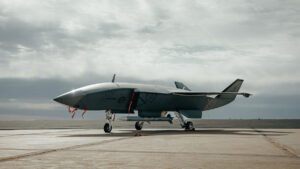
3. MQ-28 Ghost Bat
The MQ-28 Ghost Bat is not a US-built platform, but it strongly influences the direction of US military combat drones because it reflects the loyal wingman concept the US is actively pursuing. The aircraft is designed to fly alongside manned fighters, carry sensors or weapons, and absorb risk in contested airspace.
Its importance lies in the mission model. Instead of replacing piloted aircraft, the Ghost Bat demonstrates how a drone can extend fighter range, add weapons capacity, and act as a forward sensor node.
For US planners, this matters because future air campaigns will likely depend on mixed formations. Crewed aircraft will lead, while autonomous or semi-autonomous drones fill gaps, confuse enemy defenses, and provide extra firepower.
The main lesson from this concept is simple: the future is collaborative air combat. US military combat drones in 2027 will increasingly be judged by how well they integrate with fifth- and sixth-generation fighters, not by standalone performance alone.
4. XQ-58A Valkyrie
The XQ-58A Valkyrie is one of the most important experimental combat drones in the US arsenal. It was built to explore low-cost, attritable combat airpower, meaning a system that is capable but not so expensive that it must be preserved at all costs.
That philosophy is powerful. By lowering unit cost, the Valkyrie allows commanders to accept greater risk, field more aircraft, and overwhelm enemy defenses through numbers and tactics.
In 2027, its significance is tied to teaming with fighters and testing distributed operations. The platform has helped prove that US military combat drones can serve as sensor carriers, decoys, communications relays, and strike partners.
Its value is not just technical; it is strategic. If the Air Force can field affordable combat drones at scale, it changes how air superiority is maintained in a high-threat environment.
5. MQ-25 Stingray
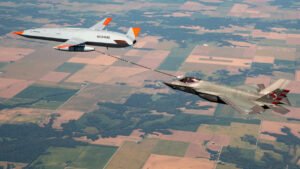
The MQ-25 Stingray is focused on a different but critical mission: aerial refueling for carrier-based aviation. While it is not a classic strike drone, it is one of the most important military drones because it directly extends the reach of naval air power.
Its biggest contribution is range. By taking over tanker duties, the MQ-25 frees up crewed aircraft to focus on combat, while also allowing carrier air wings to operate farther from threat zones.
This matters in the Pacific and other maritime theaters where distance is a major operational challenge. In 2027, the MQ-25 will likely be central to the Navy’s effort to make carrier strike groups more flexible and less dependent on vulnerable support assets.
A smart way to think about this drone is as a force multiplier. It may not always carry weapons, but it enables more effective use of every other aircraft in the carrier air wing.
6. Skyborg-aligned Autonomous Collaborative Platforms
Skyborg is not a single aircraft, but it is one of the most important programs shaping US military combat drones. It refers to the autonomy and mission system architecture designed to let drones behave more intelligently in combat.
The program’s value is in modularity and machine decision support. Instead of building one perfect drone, the US is working toward a family of platforms that can share autonomy software, adapt to mission needs, and respond faster than traditional remote-control systems.
In 2027, this approach will likely influence multiple airframes and mission sets. It helps create drones that can fly with fighters, support suppression of enemy air defenses, act as missile carriers, or serve as electronic warfare assets.
The technical insight here is that software is becoming as important as airframe design. For future US military combat drones, the quality of autonomy, sensor integration, and secure data links may matter more than size or speed.
7. Collaborative Combat Aircraft prototypes
Collaborative Combat Aircraft, or CCA, prototypes represent the clearest path to the next generation of US military combat drones. These are designed to operate alongside manned fighters, carry weapons or sensors, and reduce risk to human pilots.
The core idea is operational flexibility. A fighter pilot could direct one or more drones to scout ahead, jam enemy systems, carry additional missiles, or draw fire away from the main force.
By 2027, CCA prototypes are expected to influence procurement and doctrine even before full-scale deployment. Their impact comes from the combination of lower cost, high adaptability, and better survivability through distributed operations.
For defense professionals, the takeaway is that collaborative drones are not a niche concept. They are becoming part of the new air combat architecture, where the aircraft network matters as much as any single platform.
Summary Comparison
| Drone / Program | Primary Role | Strengths | Limitations | Best Use Case |
|---|---|---|---|---|
| MQ-9 Reaper | Armed ISR and strike | Long endurance, mature systems, versatile payloads | Limited survivability in high-threat airspace | Persistent patrol, border security, counterinsurgency |
| MQ-20 Avenger | Experimental strike and autonomy testbed | Speed, stealthier shape, mission system flexibility | Limited operational scale | Future combat concepts and autonomy testing |
| MQ-28 Ghost Bat | Loyal wingman concept model | Crew-drone teaming, forward sensing, strike support | Not a US platform, concept still maturing | Air combat teaming and distributed operations |
| XQ-58A Valkyrie | Attritable combat drone | Lower cost, risk-tolerant design, multi-role potential | Payload and endurance trade-offs | Decoys, escorts, sensors, and light strike |
| MQ-25 Stingray | Carrier tanker | Extends range, supports naval aviation, frees fighters | Not a primary strike platform | Naval refueling and carrier air wing support |
| Skyborg-aligned platforms | Autonomous mission architecture | Modular autonomy, adaptable software, faster decision support | Depends on integrated airframes | Multi-platform autonomy and teaming |
| Collaborative Combat Aircraft prototypes | Next-gen combat drone family | Scalable, lower cost, high mission flexibility | Still in development | Fighter escort, strike support, and electronic warfare |
Frequently Asked Questions (FAQs)
What makes US military combat drones different in 2027?
They are moving from simple remote-piloted aircraft to networked combat systems with autonomy, teaming, and better survivability.
Are combat drones replacing fighter jets?
No. They are designed to complement crewed aircraft by adding sensors, weapons capacity, and risk-sharing in dangerous environments.
Which drone is best for long-endurance missions?
The MQ-9 Reaper is still one of the strongest choices for long loiter time and persistent surveillance.
Why are collaborative combat aircraft so important?
They allow one pilot to control multiple drones, increasing combat reach while reducing exposure to enemy defenses.
Conclusion
The future of air power is being defined by adaptability, autonomy, and mission integration, not just raw speed or payload. The most effective US military combat drones in 2027 will be the ones that can support crewed aircraft, survive contested environments, and deliver results at lower cost.
From the MQ-9 Reaper to next-generation Collaborative Combat Aircraft, each platform shows a different piece of the same transformation. Together, they point to a future where US military combat drones become a standard part of how air campaigns are planned and executed.