7 Best Lightning Nature’s Fireworks: Earth’s Cosmic Sky Secrets 2026
Lightning does not just flash it explodes like cosmic fireworks across Earth’s sky. From storms that paint perfect galaxy spirals in thunderclouds to volcanic ash birthing blue plasma jets, our planet continuously recreates stellar explosions through billion-volt rivers of electricity. When we look up at these extreme weather events, we are seeing Lightning Nature’s Fireworks firsthand. These are not random sparks; they are complex electrical symphonies that pulse with rhythms remarkably similar to distant pulsars and quasars.
Forget basic thunderstorms. The world’s most extreme weather events create rainbow plasma highways and trace Fibonacci-like patterns across the atmosphere. If you are an adventurer or a science enthusiast, tracking Lightning Nature’s Fireworks is a dream come true. In this Universe Nature Cluster guide, we count down the absolute best locations to witness the sky shouting the universe’s deepest secrets.
1. Catatumbo, Venezuela – The Eternal Thunder Galaxy
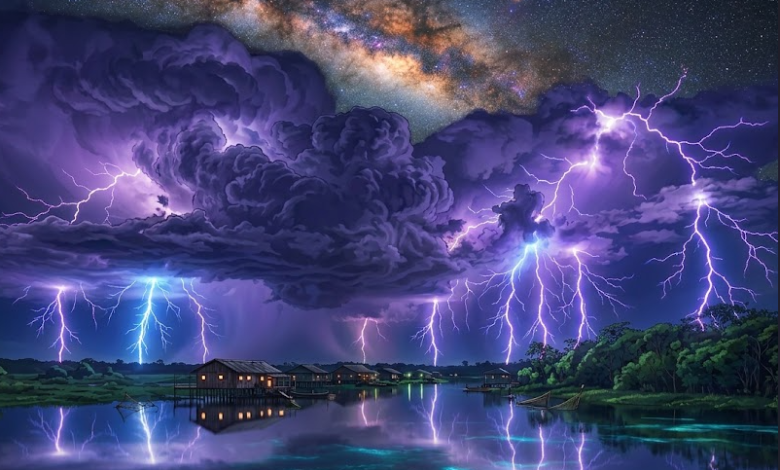
Located where the Catatumbo River meets Lake Maracaibo, this region fires up to 28 strikes per minute for about 260 nights a year. The methane-charged swamp creates ultra-conductive plasma channels that glow with a green-blue hue, matching the ionization of distant nebulas. Recognized by UNESCO as the lightning capital of the world, it generates over 1.2 billion volts nightly. Witnessing the storm clouds forming a 10km radius here is the ultimate display of Lightning Nature’s Fireworks, looking exactly like a living, electric Andromeda galaxy.
2. Maracaibo Basin, Venezuela – The Galaxy Thunder Bowl
The geography of the broader Maracaibo Basin creates the world’s most predictable storm patterns, pulsing in an exact 10 PM to 3 AM window. The circular mountain basin acts as a trap for atmospheric heat and moisture, mirroring the rotation of a galactic core trapping electric charges. Fishermen have navigated by these permanent lightning shadows for centuries. NASA continually tracks global extremely low-frequency (ELF) waves from this basin, proving it acts as a continuous loop of Lightning Nature’s Fireworks.
3. Volcanic Geothermal Basins – Volcanic Plasma Jets
While active volcanoes worldwide produce “dirty thunderstorms,” geothermal hotspots like Yellowstone spawn unique atmospheric interactions. When highly charged silica and ash particles collide violently, they can create blue plasma bolts that mirror the relativistic jets of distant quasars. This is arguably the most aggressive form of Lightning Nature’s Fireworks. The superheated environment alters the local atmospheric chemistry, illuminating the sky in vibrant, neon flashes that rival deep-space astronomical photography.
4. Tororo, Uganda – The Earth’s Pulsar Heartbeat
Historically recording over 250 thunderstorm days per year, Tororo is a global electrical anomaly. The intense lightning density here creates a massive Schumann resonance spike, producing an ELF pulse monitored worldwide by the World Meteorological Organization (WMO). The rhythm of the strikes is so consistent that it mirrors the duty cycle of a pulsar’s giant pulse. For meteorologists, the Tororo storms represent the heartbeat of Lightning Nature’s Fireworks, pulsing across the African continent in a perfect cosmic rhythm.

5. The Himalayas – Cosmic Ray Mirrors (TGFs)
At an altitude of 18km, the immense Himalayan tropopause produces Terrestrial Gamma Flashes (TGFs). These are invisible Lightning Nature’s Fireworks known as runaway electron avalanches, creating energies (up to 10¹⁷ eV) that perfectly analogize cosmic rays. Detected by passing satellites and the ISS, these pre-monsoon peaks match the heliosphere’s cosmic ray maximums. Tibetan monks historically referred to these high-altitude phenomena as “sky dragons breathing,” a poetic yet highly accurate description of advanced plasma physics.
6. Sahel, Africa – The Galactic Superbubble
The Mesoscale Convective Systems (MCS) that roll across the Sahel region of Africa are massive, 400km-diameter storms that can fire up to a million bolts per hour. The massive scale of Lightning Nature’s Fireworks here is astounding; the anvil crawlers stretch for 200km, tracing patterns that mimic galactic wind termination shocks. Radar imagery of these storm cores mirrors the contrast seen in interstellar molecular clouds, essentially making the Sahel the birthplace of Earth’s electric superbubbles.
7. Australian Outback – Red Sprites in the Upper Atmosphere
High above standard thunderstorms—around 90km in the mesosphere—dance the elusive red sprites. These 50km-tall plasma beads pulse in a rhythm resembling a neutron star. Aboriginal Dreamtime legends speak of “sky ancestors dancing” beneath the Milky Way, perfectly describing these upper-atmosphere phenomena. Documented by global NASA sky-monitoring networks, Australia offers the highest altitude Lightning Nature’s Fireworks on Earth, painting red galaxy beads directly against the edge of space.
Frequently Asked Questions (FAQs)
Q: What makes Lightning Nature’s Fireworks similar to cosmic explosions?
A: Both phenomena are governed by universal plasma physics. The rate of strikes in places like Catatumbo (28 per minute) mimics the flare rates of quasars, while the energies released in Himalayan Terrestrial Gamma Flashes exactly mirror cosmic ray emissions.
Q: Why do lightning patterns look like galactic structures?
A: Magnetic reconnection is a universal principle. The same physical laws that dictate how electricity arcs across a thunderstorm in Venezuela govern how black hole jets and galaxy spirals form in deep space.
Q: Can these extreme storms predict space weather?
A: Yes, indirectly! Global lightning networks track the Schumann resonance, which fluctuates in response to the solar wind, allowing Earth’s electrical activity to act as a mirror for space weather.
Conclusion
From the electric superbubbles of the African Sahel to the mesmerizing red sprites over the Australian Outback, chasing Lightning Nature’s Fireworks provides a breathtaking glimpse into the physics of the universe. Earth does not just experience weather; it explodes stellar symphonies nightly. If you are planning an extreme weather expedition for 2026, be sure to appreciate Lightning Nature’s Fireworks as the ultimate cosmic orchestra. Do not forget to explore our other articles in the Universe Nature Cluster for more incredible guides to Earth’s atmospheric wonders!