
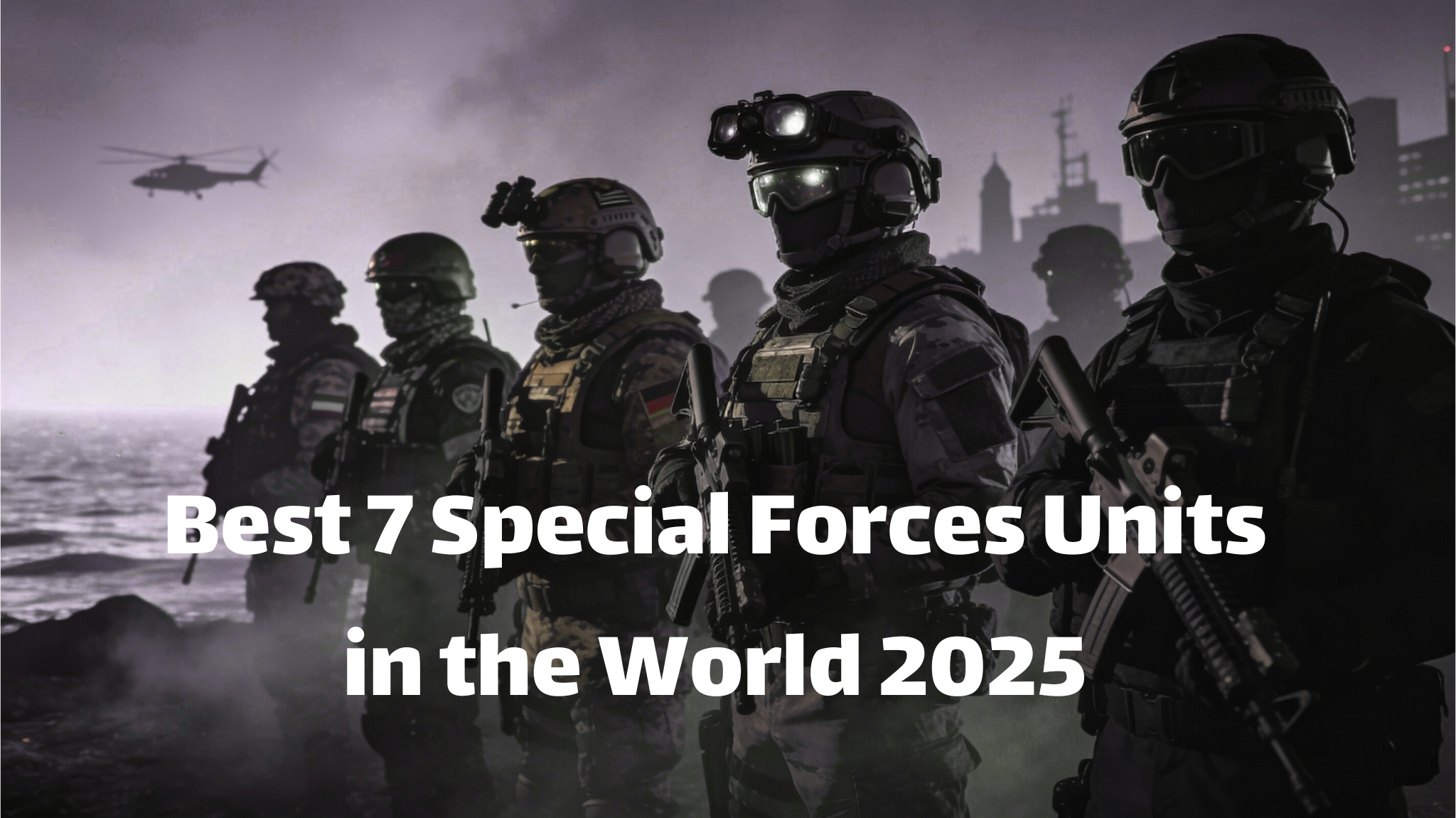
Best 7 Special Forces Units in the World 2025
Explore seven of the world’s most elite special forces units in 2025-from the Navy SEALs and SAS to GIGN, KSK, Spetsnaz, Sayeret Matkal, and Australia’s SASR—covering their core roles, history, and global reputation.
Special forces units sit at the sharp end of modern militaries, built for missions that demand speed, secrecy, and high-risk decision-making. While “best” is always subjective-and much of these units’ work remains classified—some teams stand out consistently in public records for training standards, mission scope, and long-term operational impact.
This list highlights seven of the most widely recognized special operations and counter-terror units globally, based on publicly known history, core roles (counter-terrorism, reconnaissance, direct action, hostage rescue), and reputation among defense analysts.
7- Germany — KSK
Germany’s KSK was established in 1996 to strengthen the country’s special operations capability, particularly for crisis response and overseas missions.
The unit has been associated in public reporting with deployments supporting NATO and international stabilization operations, emphasizing disciplined small-team performance and precision.
In recent years, KSK has also been in the spotlight due to reforms and restructuring efforts reported in German media and government statements, reflecting how modern special forces are not only judged by performance-but also by oversight and accountability.
6- Australia — SASR
Australia’s SASR, founded in 1957, is one of the country’s most prominent special operations formations.
It is commonly linked to long-range reconnaissance and direct-action roles, with an operational history that includes major contributions in Afghanistan and other regional security missions.
Australia’s counter-terror capability is also supported by dedicated elements within its special operations community, and the SASR’s reputation is closely tied to adaptability-operating across desert, jungle, and urban environments with a strong emphasis on selection and advanced training.
5) France — GIGN
France’s GIGN, created in 1973, is best known for counter-terrorism, hostage rescue, and high-risk law-enforcement interventions.
It gained international attention after several widely documented operations, including the 1976 Loyada hostage rescue in Djibouti and the 1994 intervention on Air France Flight 8969 in Marseille.
Unlike purely military units, GIGN sits within the French Gendarmerie, blending police authority with specialized tactical capability.
Its public reputation also rests on negotiation capacity and psychological preparation—often as important as force in real-world crises.
4) Israel – Sayeret Matkal
Sayeret Matkal is one of Israel’s most recognized special operations units, closely associated in public reporting with strategic reconnaissance and counter-terror missions. Founded in the late 1950s, it has long been described as a selective organization where intelligence-driven operations are central to its identity.
Its most famous publicly known mission remains the 1976 Entebbe hostage rescue (Operation Thunderbolt), frequently cited in military studies for its planning, speed, and coordination under extreme pressure.
3- Russia — Spetsnaz (Special Forces)
“Spetsnaz” is a broad term used for multiple Russian special-purpose units across different agencies, rather than a single force. In public defense coverage, the label commonly includes military intelligence-linked formations (often associated with the GRU) as well as notable counter-terror units tied to internal security structures.
Historically, Spetsnaz forces have been described as specializing in reconnaissance, direct action, and unconventional operations.
In the 2020s, international reporting has frequently referenced their involvement across major geopolitical conflicts—though precise unit activity is often disputed, politicized, or classified.
2- United Kingdom — SAS
The British SAS, founded in 1941, is among the most influential special forces units in modern history. It helped shape special operations doctrine used widely today, especially in counter-terrorism, covert reconnaissance, and high-risk interventions.
One of the most widely documented moments in the SAS public narrative is the 1980 Iranian Embassy siege in London, which cemented its global reputation for hostage-rescue capability.
The SAS is also frequently cited for training that prioritizes initiative, problem-solving, and resilience under uncertainty.
1- United States — Navy SEALs
The U.S. Navy SEALs, established in 1962, are built to operate across sea, air, and land—an identity that made them one of the most recognized special operations forces worldwide.
Their training pipeline, including BUD/S, is widely known (and widely reported) as among the most physically and mentally demanding in the U.S. military.
SEAL teams are publicly associated with counter-terrorism, special reconnaissance, and direct action missions. Over the past decades, their reputation has been shaped by high-profile global deployments and the broader U.S. special operations ecosystem that supports intelligence, aviation, logistics, and mission planning.
Hello, this is a good article and you have a great writing style, but your style needs more images and a broader presentation of information. I hope to see more good articles in this section.
Magnificent site. Lots of useful information here. I¦m sending it to several friends ans also sharing in delicious. And of course, thanks in your sweat!
I am glad to be a visitor of this sodding web blog! , regards for this rare info ! .
According to more accurate statistics, there are forces with higher efficiency than those mentioned here. Efficiency isn’t just about weaponry, but also about the ability to handle and adapt to events.
Excellent article, but I have a comment: the font size is too small. Please increase it.
Good info. Lucky me I reach on your website by accident, I bookmarked it.
What’s Taking place i’m new to this, I stumbled upon this I’ve found It absolutely helpful and it has helped me out loads. I’m hoping to give a contribution & help different users like its helped me. Great job.