
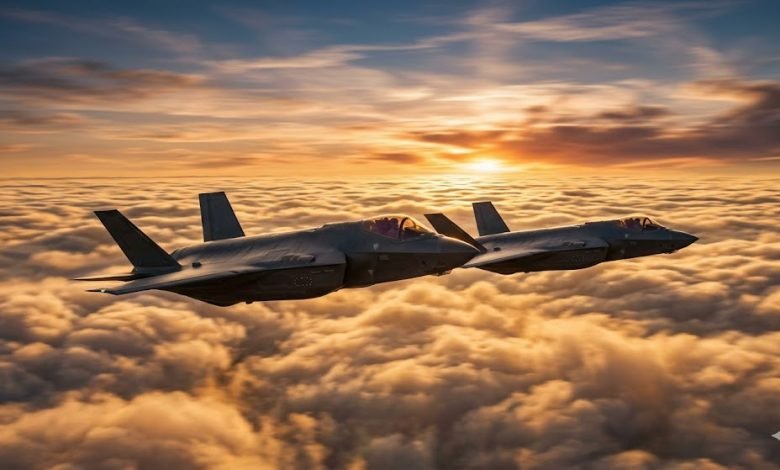
Best 7 Fifth and Sixth Generation Fighter Jets in 2026
The landscape of aerial warfare is undergoing a monumental shift. Gone are the days when dogfighting and sheer speed were the sole determining factors of air superiority. As we navigate through 2026, the battlefield in the skies is dominated by data, artificial intelligence, invisible radar signatures, and beyond-visual-range (BVR) engagements. The gap between legacy platforms and modern aircraft has expanded dramatically, giving rise to the absolute dominance of 5th and 6th-generation fighter jets.
These incredible machines are no longer just aircraft; they are flying supercomputers, interconnected nodes in a massive digital battlefield. They are designed to penetrate heavily defended airspace, process billions of lines of code per second, and neutralize threats before the enemy radar even registers a blip.
For aviation enthusiasts, defense analysts, and military technology buffs, understanding these platforms is crucial. From combat-proven veterans receiving massive software overhauls to highly classified next-generation prototypes stepping into the light, here is our comprehensive.
deep-dive guide into the best 7 fifth and sixth-generation fighter jets operating in the world in 2026.
1- F-35 Lightning II (United States): The Digital Quarterback
The Lockheed Martin F-35 Lightning II has evolved from a controversial development program into the undisputed backbone of Western airpower. Available in three distinct variants—the conventional takeoff F-35A, the short-takeoff/vertical-landing (STOVL) F-35B, and the carrier-based F-35C—it is the most versatile fighter jet ever constructed.
Technological Dominance:
What truly separates the F-35 from any other aircraft on this list is its unmatched “sensor fusion.” The aircraft is equipped with the AN/APG-81 AESA (Active Electronically Scanned Array) radar and the Electro-Optical Targeting System (EOTS). These systems gather massive amounts of data from the battlefield and seamlessly fuse them into a single, easy-to-read display on the pilot’s helmet visor. The pilot can literally look “through” the floor of the aircraft using distributed cameras.
Combat Role in 2026:
In 2026, the F-35 operates as a digital quarterback. It doesn’t just shoot down enemy planes; it identifies ground targets, hacks enemy air defense networks via electronic warfare (EW) suites, and relays targeting data to older aircraft and naval destroyers hundreds of miles away. Armed with AIM-120 AMRAAMs hidden in internal weapons bays to maintain a tiny radar cross-section (RCS), the F-35 strikes with deadly, unseen precision.
2-F-22 Raptor (United States): The Undisputed King of the Skies
Despite taking its maiden flight decades ago, the Lockheed Martin F-22 Raptor remains the apex predator of air-to-air combat. Designed during the late Cold War, its sole purpose was to establish absolute air dominance, a mission it continues to execute flawlessly.
Technological Dominance:
The F-22 possesses two distinct physical advantages over modern competitors: extreme stealth and supercruise capabilities. Driven by two Pratt & Whitney F119 turbofan engines featuring 2D thrust vectoring nozzles, the Raptor can execute maneuvers that defy standard aerodynamics. Furthermore, “supercruise” allows the F-22 to fly at supersonic speeds (Mach 1.5+) without using fuel-guzzling afterburners, significantly extending its combat range while maintaining its stealth profile.

Combat Role in 2026:
While it lacks the ground-attack versatility and advanced sensor fusion of the F-35, the F-22 is the ultimate “door kicker.” In a hypothetical high-end conflict in 2026, the Raptor’s job is to fly deep into hostile territory completely undetected, eliminate enemy fighter jets, destroy airborne early warning (AEW) aircraft, and clear the airspace for other friendly forces.
3- Chengdu J-20 “Mighty Dragon” (China): The Eastern Giant
The Chengdu J-20 represents China’s definitive entry into the 5th-generation club and serves as the primary symbol of the People’s Liberation Army Air Force (PLAAF) modernization. It is a massive, twin-engine stealth fighter built specifically for long-range interception and strike missions in the vast Indo-Pacific theater.
Technological Dominance:
Initially reliant on Russian engines, the 2026 variants of the J-20 are fully equipped with indigenous WS-15 turbofan engines, finally granting the aircraft true supercruise capabilities and improved thrust-to-weight ratios. The J-20 features a unique canard-delta wing configuration, which, combined with advanced stealth coatings, makes it highly elusive, particularly from the front.
Combat Role in 2026:
The J-20 is not primarily designed for close-range dogfighting. Instead, it is an airborne sniper. Its massive internal weapon bays carry the PL-15 beyond-visual-range air-to-air missile, which possesses an exceptionally long range. The J-20’s strategic doctrine involves bypassing enemy fighter screens to hunt down high-value targets, such as aerial refueling tankers and command-and-control aircraft, effectively blinding the enemy.
4- Sukhoi Su-57 “Felon” (Russia): The Acrobat with Claws
Russia’s Sukhoi Su-57, NATO reporting name “Felon,” is perhaps the most heavily debated 5th-generation fighter. While Western analysts often critique its radar cross-section as being larger than the F-35 or F-22, the Su-57 approaches 5th-generation warfare from a distinctly Russian design philosophy, prioritizing hyper-maneuverability and heavy firepower over pure stealth.
Technological Dominance:
The Su-57 is a masterpiece of aerodynamic engineering. Featuring 3D thrust-vectoring engines, it can perform jaw-dropping aerobatics like the “Pugachev’s Cobra,” allowing it to rapidly change its nose direction to lock onto enemy targets in a close-quarters dogfight. It also features a unique radar arrangement, utilizing side-looking cheek radars in addition to the main nose radar, giving the pilot an exceptionally wide field of view.
Combat Role in 2026:
The Su-57 is designed to be a highly aggressive, multi-role platform. It is equipped to carry a wide array of specialized weaponry, including the devastating Kh-69 stealth cruise missile. Furthermore, in 2026, the Su-57 is being heavily integrated with the S-70 Okhotnik-B heavy stealth drone, allowing the manned fighter to direct unmanned wingmen to conduct strikes while the pilot remains in safe airspace.
5- KAI KF-21 Boramae (South Korea): The Rapid Innovator
South Korea’s Korea Aerospace Industries (KAI) KF-21 Boramae is the dark horse of modern military aviation. Originally classified as a 4.5-generation fighter because its initial Block I prototypes carried weapons externally, the highly anticipated Block II and III variants operating in 2026 have cemented its status as a formidable 5th-generation platform.
Technological Dominance:
The KF-21 is a testament to incredibly rapid technological development. It features a state-of-the-art indigenous AESA radar, an advanced infrared search and track (IRST) system, and fully integrated internal weapons bays in its later blocks. It is heavily influenced by the F-22’s aerodynamic shape, ensuring a minimal radar signature.
Combat Role in 2026:
The KF-21 is designed to be a highly capable yet cost-effective alternative to the F-35. It provides South Korea, and its export partners, with an affordable way to field massive numbers of stealth fighters. Armed with European Meteor air-to-air missiles, which feature a throttleable ramjet engine for unparalleled end-game speed, the KF-21 is a lethal defender of airspace and a highly successful export commodity.
6-NGAD Prototype (United States): The Dawn of the 6th Generation
The Next Generation Air Dominance (NGAD) program is the United States Air Force’s highly classified leap into the 6th generation of air combat. While traditional jets are viewed as single platforms, NGAD is an entire “family of systems,” fundamentally changing how air wars are fought.
Technological Dominance:
Though shrouded in secrecy, 2026 flight tests and declassified concepts reveal a revolutionary tailless design. Removing the vertical tail fins significantly reduces radar return and drag, optimizing the aircraft for extreme range and high-altitude stealth. NGAD is powered by advanced variable-cycle engines, which can dynamically switch between high-thrust fighter modes and high-efficiency commercial airliner modes to maximize range in the Pacific theater.
Combat Role in 2026:
The defining characteristic of the NGAD fighter is its role as a command node for Collaborative Combat Aircraft (CCA)-highly advanced, AI-driven “loyal wingman” drones. The human pilot in the NGAD jet acts more like a battlefield tactician, directing swarms of autonomous drones that fly ahead to draw enemy fire, jam radars, or launch their own missiles. It represents the ultimate fusion of human decision-making and artificial intelligence.
7- GCAP / Tempest (UK, Italy, Japan): The Global Alliance
The Global Combat Air Programme (GCAP), previously known primarily by its British component “Tempest,” is a monumental tri-national effort to field a 6th-generation fighter jet. It represents the finest aerospace engineering of Europe and Asia combined, aiming to field a fully operational system by the mid-2030s, with highly advanced prototypes flying aggressively in 2026.
Technological Dominance:
The GCAP aircraft focuses heavily on the pilot interface and energy generation. It features a “wearable cockpit,” completely abandoning physical dials and screens in favor of an Augmented Reality (AR) helmet that projects the entire battlespace directly into the pilot’s eyes. Furthermore, the aircraft generates unprecedented levels of electrical power to support advanced directed-energy weapons (lasers) capable of blinding enemy missiles mid-flight.
Combat Role in 2026:
Equipped with an Integrated Sensing and Non-Kinetic Effects (ISANKE) system, the GCAP fighter processes data at tens of thousands of times the speed of legacy systems. It is designed to be a highly survivable, deep-penetration strike and air-superiority fighter, ensuring that the allied nations maintain technological overmatch against any potential near-peer adversary well into the late 21st century.
Understanding the Tech: 5th Gen vs 6th Gen
To fully appreciate these machines, it is vital to understand the technological leaps defining their generations:
– 5th Generation:
Characterized by built-in stealth (not bolted on), Advanced AESA radars, supercruise capabilities, and extensive sensor fusion. The pilot manages the battle, not just the aircraft.
– 6th Generation:
The incoming era focuses on AI integration, teaming with autonomous drones, directed energy weapons (lasers), variable cycle engines for extreme range, and advanced “skin sensors” where the entire body of the aircraft acts as a radar receiver.
Conclusion
As we observe the military landscape of 2026, the skies are guarded by the most complex engineering marvels ever created. The 5th-generation stalwarts like the F-35 and J-20 continue to mature, refining their software and weapon systems to become deadlier every year.
Meanwhile, the shadowy prototypes of the 6th generation, such as NGAD and GCAP, are rewriting the rules of engagement entirely by bringing artificial intelligence and unmanned combat vehicles into the fold.
Air superiority is no longer guaranteed by who has the most planes, but by who possesses the fastest processors, the most elusive stealth coatings, and the smartest algorithms.
For any nation looking to secure its borders in the 21st century, investing in these advanced fighter jets is not a luxury; it is an absolute strategic necessity.



hello!,I like your writing so much! share we communicate more about your article on AOL? I need an expert on this area to solve my problem. May be that’s you! Looking forward to see you.