
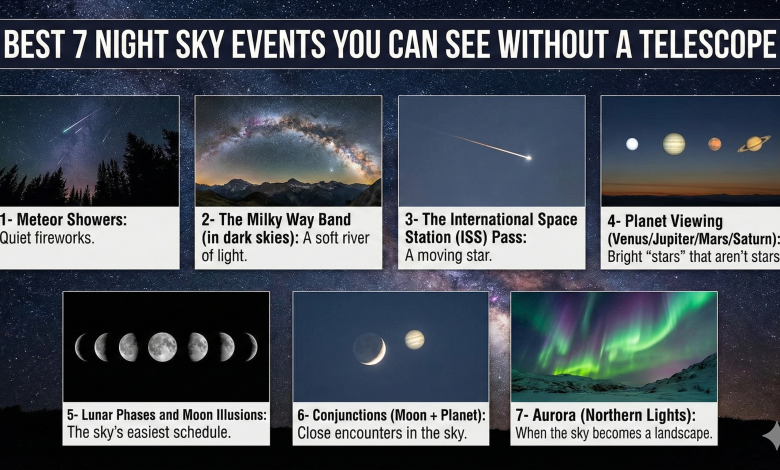
7 Best Night Sky Events You Can See Without a Telescope
Best 7 Night Sky Events (No Telescope Needed)
You don’t need a telescope to feel close to the universe. The night sky has a quiet rhythm—events that appear on schedule, and others that arrive unexpectedly if you know where to look. This guide gathers the best seven night-sky events you can see with your own eyes, chosen for being beginner-friendly, widely visible, and genuinely beautiful without special gear. If your journey started with Earth’s landmarks, begin with Best 7 Natural Wonders in the World That Look Unreal and return here at night for a different kind of wonder.
Quick Summary Box
Best for: Beginners, casual stargazers, travelers.
What you need: A dark spot, patience, and 10–20 minutes for your eyes to adjust.
Avoid: Bright phone screens and strong streetlights.
The Best 7 Night Sky Events You Can See Without a Telescope
1- Meteor Showers: Quiet fireworks
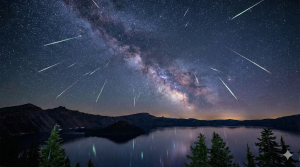
What it is: Streaks of light (“shooting stars”) as small particles burn up in Earth’s atmosphere.
Why it’s special: It’s one of the most rewarding events for beginners—no equipment, just time under the sky.

How to experience it:
Best time: Usually after midnight into pre-dawn hours (varies by shower).
Best tip: Lie back and watch a wide patch of sky; don’t stare at one point.
Simple rule: The darker the sky, the better.
Quick fact: The best meteor nights feel slow at first then suddenly generous.
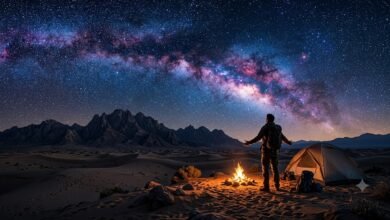
2- The Milky Way Band (in dark skies): A soft river of light
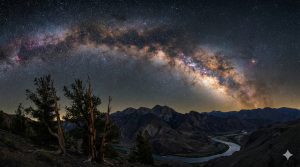
What it is: The visible glow of our galaxy when light pollution is low.
Why it’s special: It’s not loud or sharp-it’s subtle, and that’s what makes it feel timeless.
How to experience it:
Best time: Moonless nights help a lot.
Best tip: Give your eyes 15–20 minutes to adapt to darkness.
Where: Away from cities; even a short drive can help.
Quick fact: Many people “can’t see it” until they stop checking their phone.
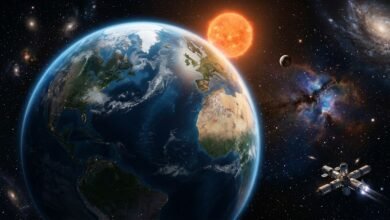
3- The International Space Station (ISS) Pass: A moving star
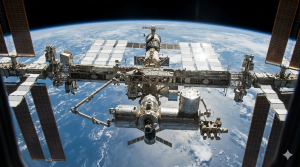
What it is: A bright, fast-moving point of light crossing the sky (no blinking like airplanes).
Why it’s special: It’s a real object in orbit—watching it connects the sky to human exploration.
How to experience it:
Best time: Early evening or pre-dawn passes are often easiest.
Best tip: Look up pass times for your city and be outside a few minutes early.
What to expect: A steady bright light that glides across the sky.
Quick fact: It can be brighter than most stars when conditions are right.
4- Planet Viewing (Venus/Jupiter/Mars/Saturn): Bright “stars” that aren’t stars.
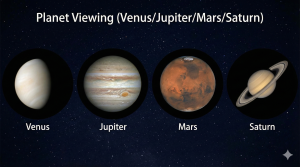
What it is: Planets visible to the naked eye as steady bright points.
Why it’s special: Planets look calm and bright—and once you learn them, the sky feels more “readable.
How to experience it:
Best time: Depends on the planet’s position and season.
Best tip: If it’s very bright and doesn’t twinkle much, it might be a planet.
Simple method: Learn one planet at a time.
Quick fact: The best beginner skill is not memorizing it’s recognizing patterns.
5- Lunar Phases and Moon Illusions: The sky’s easiest schedule
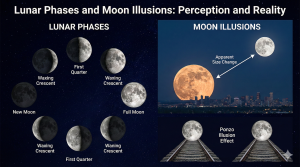
What it is: The Moon’s changing shape across the month, plus illusions near the horizon.
Why it’s special: The Moon teaches timing: bright nights vs dark nights, and how light changes the landscape.
How to experience it:
Best time: Any time-just match your goal (bright Moon for scenery, no Moon for stars).
Best tip: Watch the Moon near the horizon for dramatic size illusions.
Photo tip: Use the Moon as a “light source” for foreground landscapes.
Quick fact: Understanding the Moon instantly upgrades stargazing plans.
6- Conjunctions (Moon + Planet): Close encounters in the sky
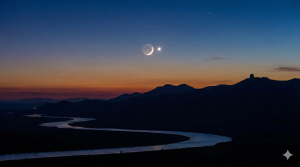
What it is: When two objects appear close together from our viewpoint (they aren’t actually near each other).
Why it’s special: It looks elegant and rare—like the sky briefly “arranged itself.”
How to experience it:
Best time: Specific nights; check a sky calendar or astronomy app.
Best tip: Conjunctions can be brief—don’t wait too late.
Photo tip: Include a simple foreground to show scale.
Quick fact: Many of the best sky moments are quiet alignments, not big explosions.
7- Aurora (Northern Lights): When the sky becomes a landscape
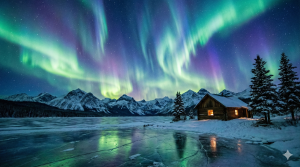
What it is: A natural glow and shifting curtains of light at higher latitudes.
Why it’s special: It feels less like “seeing an event” and more like “standing inside a living sky.”
How to experience it:
Best time: Dark, clear nights in aurora season; activity varies.
Best tip: Cloud cover matters as much as aurora activity.
Next step: Use the full travel guide once published/available.
Quick fact: Sometimes the aurora looks faint to the eye but appears stronger in photos.
Common Mistakes (and Simple Fixes)
Looking for stars immediately. Fix: Wait 15–20 minutes for darkness to adjust.
Choosing a “pretty” place that is too bright. Fix: Prioritize darkness over scenery at first.
Checking your phone every minute. Fix: Dim screen and use red-light mode if possible.
Expecting everything to look like astrophotography. Fix: Enjoy subtle detail; photos often amplify faint light.
FAQ: Quick Answers
Q1: Can I really see night-sky events without a telescope?
A: Yes many of the most beautiful celestial events are designed almost for the naked eye: meteors, the moon, bright planets, and some of the bright streaks of orbiting objects.
Q2: What’s the best time for stargazing?
A: The best time is usually when the sky is clear, artificial light is minimal, and the moon isn’t too bright if the goal is stargazing.
Q3: How do I find a darker place near my city?
A: Start by going outside the city for 20–60 minutes and look for open spaces (fields, hills, lakes) with a wide horizon.
Q4: Why do stars twinkle but planets often don’t?
A: Stars are very far away and are more affected by atmospheric turbulence, while planets appear slightly larger and therefore more stable.
Q5: What’s the easiest first event to watch?
A: The moon (its phases) plus a bright planet (like Venus or Jupiter when they are visible) are the easiest and most satisfying starting points for beginners.
Short Conclusion
The best stargazing isn’t about having more gear—it’s about seeing more clearly. Which event would you like to try first this week: a meteor shower night, a planet spot, or a Moon phase walk? Next in the series: Best 7 Milky Way Facts Explained.
A great article, containing new information that I am reading for the first time.
You have mentioned very interesting points! ps nice site.