
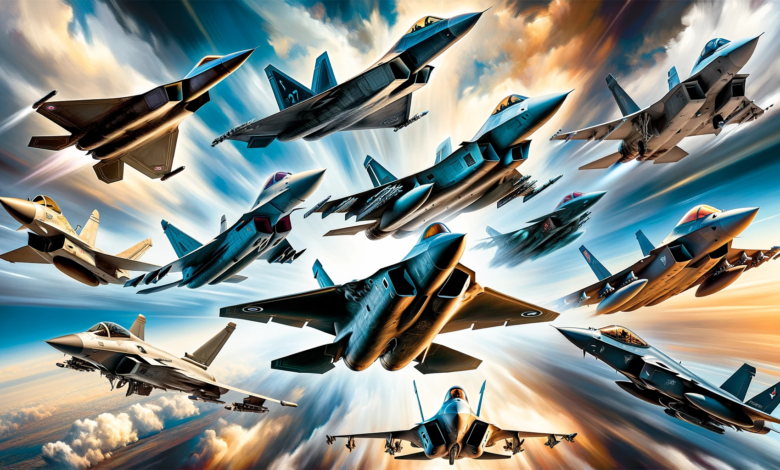
Best 7 Fighter Jets in the World 2025
In the era of great‑power competition and rapidly evolving defense technology, modern fighter jets sit at the center of any nation’s airpower strategy. These aircraft combine stealth, advanced sensors, electronic warfare, and precision weapons to secure control of the skies and strike targets at long range.
This 2025 guide to the top 7 fighter jets in the world looks at the aircraft that currently set the standard for air superiority, multirole capability, and next‑generation combat systems.
7- Lockheed Martin F-35 Lightning II – USA
The F-35 Lightning II has become the backbone of Western airpower in 2025. Designed as a multirole, fifth‑generation stealth fighter, it comes in three main variants: the F-35A (conventional takeoff), F-35B (short takeoff/vertical landing), and F-35C (carrier-based).
Now operated by more than a dozen countries, including the United States, United Kingdom, Italy, Japan, South Korea, Israel, and several NATO allies, the F-35 offers:
– Low-observable stealth and reduced radar cross‑section.
– Advanced sensor fusion that combines data from radar, infrared, and electronic support measures.
– Secure networking to act as an “information node” for other aircraft and ground units.
Recent upgrades, including the **Technology Refresh 3 (TR-3) hardware and the planned Block 4 software suite, enhance weapons compatibility, electronic warfare performance, and processing power. While integration delays have pushed some deliveries to the right, the F-35 remains the most widely fielded fifth‑generation fighter in the world.
6- Chengdu J-20 Mighty Dragon – China
China’s Chengdu J-20 “Mighty Dragon” is the spearhead of the People’s Liberation Army Air Force (PLAAF) in the Pacific region. As a fifth‑generation, long‑range stealth fighter, the J-20 is optimized for:
– Penetrating contested airspace.
– Engaging high-value assets such as tankers and AWACS.
– Long-range air‑to‑air combat with advanced missiles.
Since its initial entry into service, China has expanded J-20 deployments to several key airbases and steadily increased production. Newer variants are believed to feature:
– Indigenous WS-10C engines, with testing of the more powerful WS-15 reportedly underway.
– Upgraded avionics and datalinks to work in tandem with J-16 and KJ-500 airborne early warning platforms.
– Improved radar and electronic warfare systems designed to counter rival stealth aircraft.
Although many details remain classified, the J-20 clearly signals China’s ambition to challenge U.S. and allied air superiority in the Indo‑Pacific.
5- Boeing F/A-18E/F Super Hornet – USA
The Boeing F/A-18E/F Super Hornet continues to serve as the workhorse of the U.S. Navy’s carrier air wings in 2025. While newer platforms like the F-35C are joining the fleet, the Super Hornet remains indispensable thanks to its:
– Twin‑engine reliability for over‑water operations.
– Ability to perform both air‑to‑air and air‑to‑ground missions from aircraft carriers.
– Robust design, proven in decades of real‑world operations.
The latest Block III Super Hornet upgrades extend the jet’s relevance, adding:
– An advanced cockpit with large-area displays and improved pilot interface.
– Enhanced networking and sensor fusion to operate in future “combat cloud” environments.
– Reduced radar signature through refined shaping and coatings.
Although the U.S. Navy plans to transition toward next‑generation air dominance programs in the 2030s, the F/A-18E/F will remain on the front line of naval aviation for years to come.
4- Dassault Rafale – France
The Dassault Rafale has evolved from a national project into a global export success and a true omnirole fighter. Flown by France, Egypt, India, Qatar, Greece, Croatia, Indonesia, and others, the Rafale is prized for its flexibility and upgrade path.
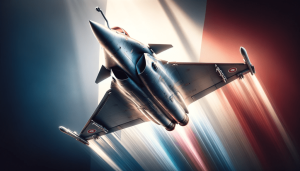
Key strengths include:
– Capability to perform air superiority, deep strike, reconnaissance, and nuclear deterrence missions.
– Advanced electronic warfare suite SPECTRA, enhancing survivability in high-threat environments.
– Compatibility with a wide range of weapons, including Meteor beyond-visual-range missiles and SCALP/Storm Shadow cruise missiles.
The latest F3R and F4 standards bring:
– Improved radar performance and sensor fusion.
– Enhanced connectivity with ground, naval, and aerial assets.
– Better integration of new smart weapons and upgraded electronic warfare systems.
With continuing orders and a clear roadmap for future upgrades, the Rafale remains one of the most capable and exportable 4.5‑generation fighter jets in the world.
3. Eurofighter Typhoon – European Consortium
Developed by a consortium of the United Kingdom, Germany, Italy, and Spain, the Eurofighter Typhoon is a cornerstone of European air defense. In service with several European and Middle Eastern air forces, the Typhoon is known for:
– Exceptional agility and high thrust‑to‑weight ratio, ideal for dogfighting and rapid climb.
– Strong performance in both air‑to‑air and precision strike missions.
– A modular design that supports incremental modernization.
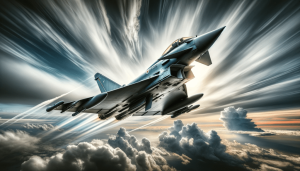
Recent upgrades and ongoing programs include:
– The Captor-E AESA radar, significantly improving detection range, tracking, and resistance to jamming.
– Enhanced electronic warfare and defensive aids suites.
New weapons integration, including the Meteor BVR missile and Storm Shadow cruise missile.
With specialized variants under development, including an Electronic Combat Role (ECR) version for suppression of enemy air defenses (SEAD), the Eurofighter Typhoon remains one of the most formidable and adaptable fighters in 2025.
2. Sukhoi Su-57 Felon – Russia
The Sukhoi Su-57, known by its NATO reporting name “Felon,” is Russia’s flagship fifth‑generation fighter. Designed primarily for air superiority with strong multirole capability, the Su-57 combines:
Reduced‑observable shaping and internal weapons bays.
Supermaneuverability enabled by thrust‑vectoring engines.
A modern suite of sensors and electronic warfare systems.
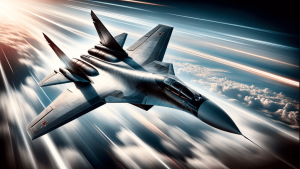
Russia claims to have used the Su-57 in combat roles during the ongoing conflict in Ukraine, though details and numbers remain limited. The aircraft is still in low‑rate production, with only a modest fleet currently in operational service.
Key development areas to watch include:
Full introduction of the next‑generation engine often referred to as “Izdeliye 30” for improved thrust and efficiency.
Expanded integration of advanced air‑to‑air and air‑to‑surface weapons.
Efforts to market an export variant, the Su-57E, although no confirmed export customers have been announced as of 2025.
Despite production challenges, the Su-57 represents Russia’s most advanced attempt to field a true fifth‑generation fighter jet.
1. Lockheed Martin F-22 Raptor – USA
Nearly two decades after entering service, the F-22 Raptor still sets the benchmark for air superiority fighters in 2025. Purpose‑built for dominance in the skies, the F-22 combines:
Extreme stealth with a very low radar cross‑section.
Supercruise capability, allowing sustained supersonic flight without afterburners.
High agility supported by thrust‑vectoring and advanced aerodynamics.
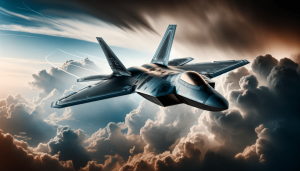
While U.S. production ended in 2012 and the fleet is relatively small (around 180 aircraft built, with some early models now being retired), the F-22 continues to receive selective upgrades to:
Avionics and mission systems.
Communications and datalinks to better integrate with F-35s and future platforms.
Electronic warfare capabilities and situational awareness tools.
The U.S. Air Force plans to eventually replace the F-22 with its Next Generation Air Dominance (NGAD) program in the 2030s, but until then, the Raptor remains arguably the most capable air‑to‑air combat aircraft on the planet.
Why These Fighter Jets Matter in 2025
These seven fighter jets represent the cutting edge of modern military aviation. Together, they illustrate several key trends shaping air warfare in 2025:
The shift toward stealth and sensor fusion, as seen in the F-22, F-35, J-20, and Su-57.
The enduring value of upgradable 4.5‑generation platforms like the Rafale, Eurofighter Typhoon, and F/A-18E/F Super Hornet.
Increasing emphasis on networked warfare, where fighters act as nodes in an integrated combat cloud rather than operating alone.
As nations invest heavily in new technologies—artificial intelligence, loyal wingman drones, and sixth‑generation fighters—these aircraft will continue to evolve. For now, they remain the best fighter jets in the world, defining how airpower is projected and how air superiority is won.


Hello, this is a good article and you have a great writing style, but your style needs more images and a broader presentation of information. I hope to see more good articles in this section.
Hello, this is a good article and you have a great writing style, but your style needs more images and a broader presentation of information. I hope to see more good articles in this section.
Sweet web site, super style and design, very clean and utilise pleasant.
I’ll right away take hold of your rss as I can not find your email subscription hyperlink or newsletter service. Do you have any? Kindly permit me recognize so that I may subscribe. Thanks.
Thanks for another great post. Where else could anybody get that type of information in such an ideal way of writing? I’ve a presentation next week, and I’m on the look for such information.
I do enjoy the way you have presented this specific issue plus it does indeed give me a lot of fodder for thought. Nonetheless, from what I have experienced, I just simply hope when other responses pack on that people keep on issue and don’t embark upon a tirade associated with some other news du jour. All the same, thank you for this fantastic piece and whilst I do not necessarily agree with this in totality, I respect the point of view.