
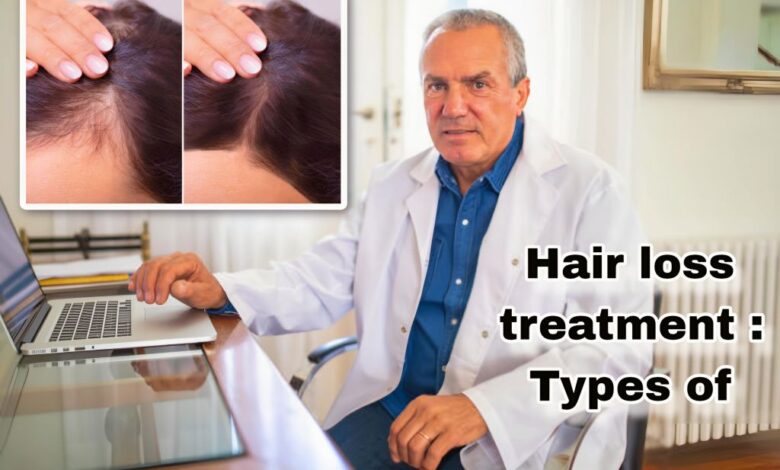
Hair Loss Treatment: Types of Hair Loss, Causes, and What Works
Hair loss treatment in 2025 starts with one rule: identify the type of hair loss first, because the “best” treatment for genetic thinning is different from sudden shedding after stress or an autoimmune flare-up. Evidence-based options now range from classic therapies like minoxidil and finasteride to newer FDA-approved JAK-inhibitors for severe alopecia areata.
A 2025 guide to hair loss treatment: learn the main types of hair loss, how dermatologists diagnose it, and proven treatments—from minoxidil/finasteride to FDA-approved JAK inhibitors for alopecia areata.
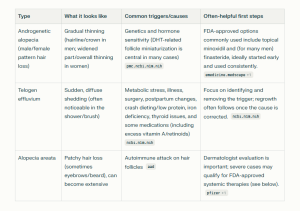
Types of hair loss
Different hair-loss patterns point to different causes-and different treatment plans.
What diagnosis looks like in 2025
Dermatologists typically diagnose hair loss by combining history (timing, stressors, medications, diet), scalp exam, and sometimes dermoscopy or lab work to look for treatable contributors.
Because psychological stress is linked with several hair and scalp conditions—including telogen effluvium and possibly alopecia areata-clinicians often ask about recent life events and sleep patterns as part of the workup.
Hair loss treatment options (what actually works)
The most reliable plan is usually a “stack” of treatments: a proven medication plus realistic lifestyle and scalp-care habits, with procedures added when needed.
Pattern hair loss (androgenetic alopecia):
The two FDA-approved drug options widely referenced for androgenetic alopecia are minoxidil and finasteride.
Alopecia areata (severe):
The FDA has approved oral JAK-inhibitors for severe alopecia areata, including baricitinib (Olumiant) for adults.
Alopecia areata (teens + adults):
Ritlecitinib (Litfulo) is FDA-approved in the U.S. for severe alopecia areata in adults and adolescents ages 12 and older.
Another FDA-approved option for adults:
Deuruxolitinib (Leqselvi) has been reported as FDA-approved for severe alopecia areata in adults.
Procedural add-ons (selected patients): Platelet-rich plasma (PRP) is being studied and used by some dermatologists as a possible hair-loss treatment, but availability, protocols, and outcomes vary.
Hello, this is a good article and you have a great writing style, but your style needs more images and a broader presentation of information. I hope to see more good articles in this section.
Awsome site! I am loving it!! Will come back again. I am bookmarking your feeds also
When I originally commented I clicked the -Notify me when new comments are added- checkbox and now each time a comment is added I get four emails with the same comment. Is there any way you can remove me from that service? Thanks!
I am not sure where you’re getting your information, but great topic. I needs to spend some time learning much more or understanding more. Thanks for great information I was looking for this info for my mission.
When I originally commented I clicked the -Notify me when new comments are added- checkbox and now each time a comment is added I get four emails with the same comment. Is there any way you can remove me from that service? Thanks!